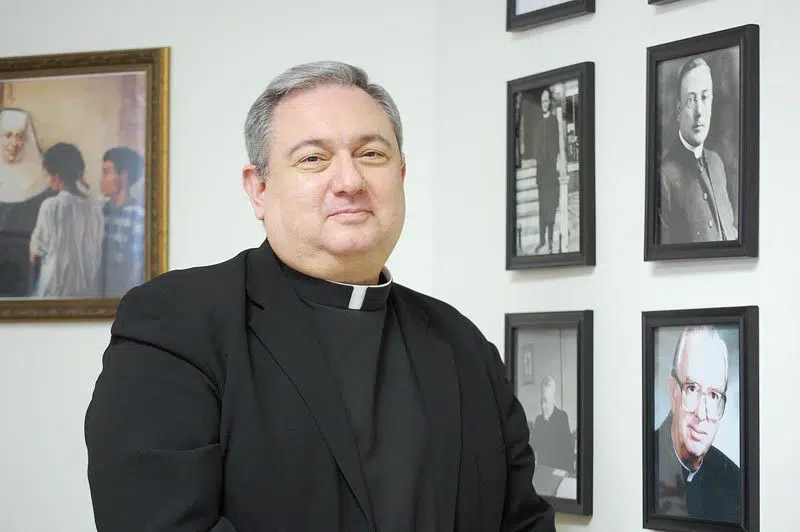
Father Wayne Paysse follows in the footsteps of great
missionary-spirited priests whose pictures hang on the
conference room wall at the Black and Indian Mission Office,
along with paintings of Philadelphia philanthropist and
religious sister St. Katharine Drexel and Mohawk Indian
Blessed Kateri Tekakwitha. Founded in 1884, the organization
has a rich history. As executive director since 2007, Father
Paysse is the seventh in his post, serving the mission to
evangelize African-American and Native American communities
in the United States.
The office is appropriately headquartered in a historic brick
Washington, D. C., home once owned by St. Katharine Drexel,
who dedicated her life to serving oppressed minorities. Its
walls are decorated with beautiful art and colorful
handicrafts of the diverse people the organization serves.
The Black and Indian Mission Office is the umbrella
organization that encompasses the Bureau of Catholic Indian
Missions, the Black and Indian Mission Collection and the
Catholic Negro-American Mission Board.
“I live in the home of a saint,” Father Paysse said,
explaining how the organization obtained its location. “She
sold the house to us for $1.”
Father Paysse spends two to three weeks a month visiting
mission locations across the country, assessing situations,
and recruiting support for the important and never-ending
needs of the many poverty-stricken communities he serves.
Through his office, grants are dispersed to bishops to
further their efforts in serving African-Americans and Native
Americans – after meeting Father Paysse’s approval and
undergoing the scrutiny of the board of directors, which
includes Philadelphia Cardinal Justin Rigali, Baltimore
Archbishop Edwin O’Brien and New York Archbishop Timothy
Dolan.
Father Paysse’s many stories of appreciation are
heartwarming.
“In April of 2007 there was a black Catholic community in the
diocese of Austin, Texas, that needed hymnals,” he said. “A
grant was given so they could buy them. They wanted me to
visit, so I drove up and there were the wonderful people
standing in front of the church holding the hymnals. They
sang when we went in church.”
Physical poverty is often accompanied by great spiritual
depth and love for Our Lord, he said, in addition to devotion
to the Church.
“I’ll never forget the first time I set foot on a
reservation,” Father Paysse said about a visit to a Native
American Catholic ministry in Phoenix. “It’s like another
world. Despite the extreme poverty, the people were so happy
and loving. They had the biggest smiles. They had a huge
choir.”
His organization is able to support Catholic religious
education programs that benefit churches, urban centers,
reservations, inner-city schools and small village parishes.
In the Arlington Diocese, the Black and Indian Mission Office
has provided grant money for tuition assistance for
financially stricken minority families. Donations from the
diocese have improved the lives of many.
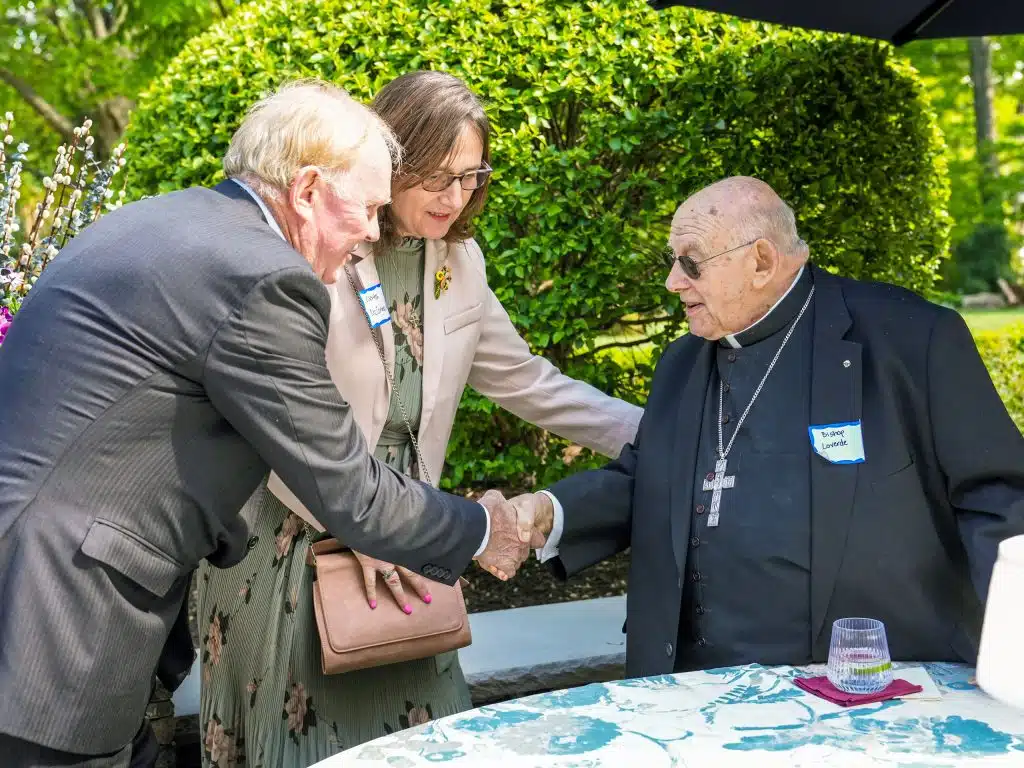
“I am most grateful to (Arlington) Bishop (Paul S.) Loverde
and the Arlington Diocese for their support,” said Father
Paysse. “This diocese is one of the most generous.”
In 2010, more than $221,000 was donated from the Arlington
Diocese at the second collection designated for the Black and
Indian Mission Office, which takes place this year the
weekend of March 12-13.
Father Paysse’s passion for the missions began as a young boy
when he heard stories from visiting missionary priests in his
hometown of New Orleans. His aunt, a parish sacristan, hosted
breakfasts for guest priests after Sunday Mass. Young Paysse
was invited to come and listen to their exciting accounts.
Growing up in a devout Catholic home, surrounded by Sicilian
relatives and wonderful priests, he received formation for
his future of serving as a missionary.
“I thought everyone was Catholic and Sicilian,” he said
laughing.
His Catholic upbringing included daily rosaries after school
with his mother and siblings, along with his grandparents who
lived next door. On Saturdays he enjoyed helping the parish
priests, often working in the churchyard.
“My whole life was centered around the parish,” he said.
“Since the second grade, I was interested in being a priest,”
said Father Paysse. “I admired my pastor who was so holy in
church and very human. He would take the (Catholic Youth
Organization youths) to Florida, take us swimming, camping
and on trips. Monsignor was always with the parish, the men’s
club, the altar society.”
Following high school graduation in 1979, Father Paysse
entered St. Joseph Seminary College, run by Benedictines
monks, in St. Benedict, La., and earned a bachelor’s in
philosophy.
“I loved the seminary,” Father Paysse said. He knew
immediately that he was in the right place and enjoyed the
spirit of service and hospitality.
“I would prepare and serve the meals and sit with the monks.
Afterward, I would wash the pots and pans,” he said.
In addition to his natural spirit of service, Father Paysse
had a gift for leadership. He served in student government at
the monastery and was often selected as driver for the monks,
hearing about their lives and learning from their examples of
faith.
In 1987, he received a master’s of divinity from the
University of Notre Dame in South Bend, Ind., and was
ordained. He was named associate pastor of St. Genevieve
Parish in New Orleans as his first assignment. Through the
years, he served as pastor of three churches in New Orleans,
serving African-American, Native American and biracial
communities. He served as a spiritual director and adjunct
professor at St. Joseph before being named diocesan director
of the Society for the Propagation of the Faith in New
Orleans.
All of his experiences prepared him for his current
assignment at the Black and Indian Mission Office. Because of
his heavy travel schedule and small staff, Father Paysse
often rises at 4 a.m. and works late into the evenings to fit
in his work and prayer time. He says he loves his job being a
missionary.
“I do it because I love God,” he said. “When you love God, it
all works out. Often we say, ‘How will we do it? We don’t
have the money.’ We pray and God makes it all happen.”
Socarras is a freelance writer from Annandale.
Find out more