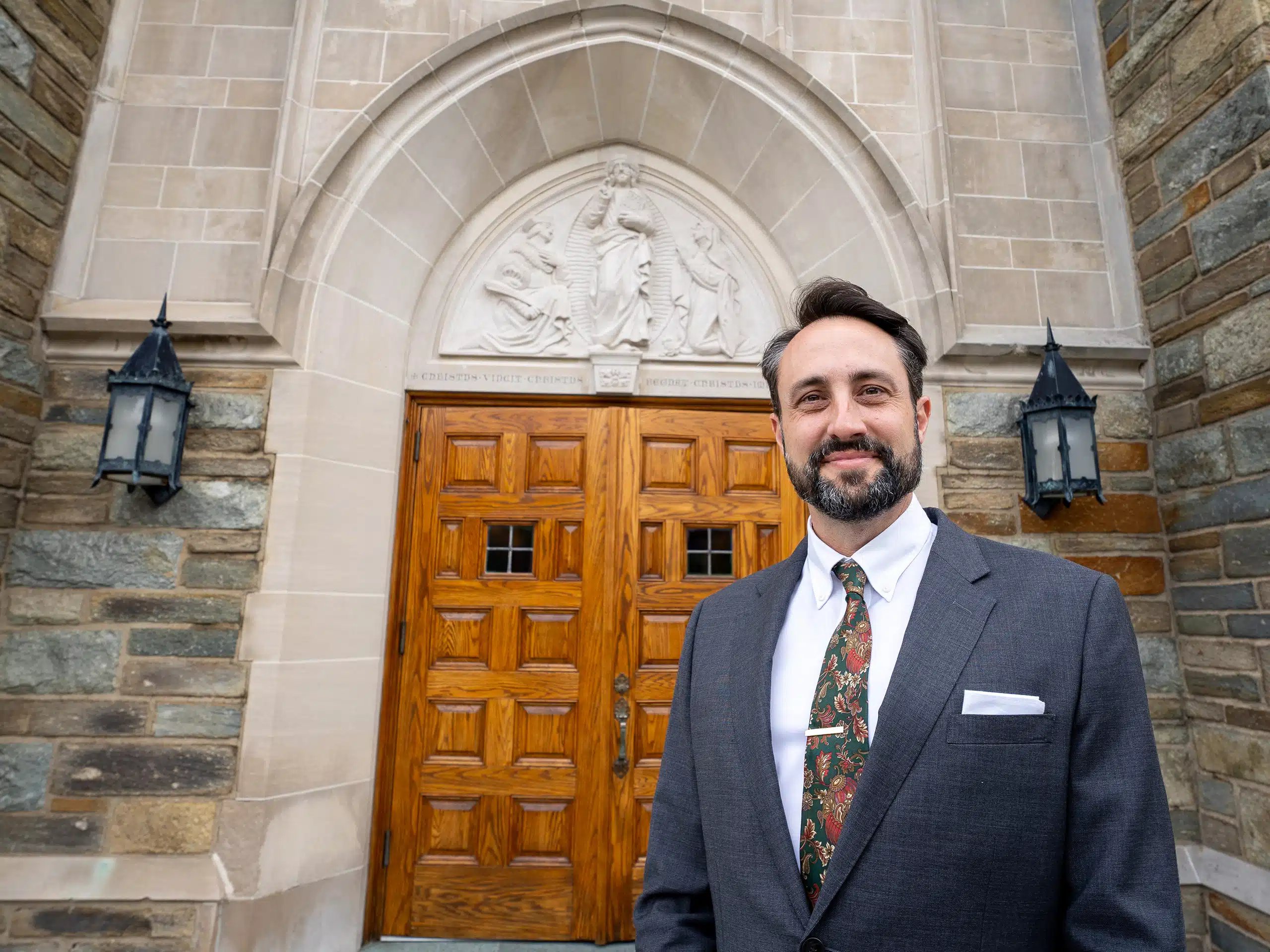

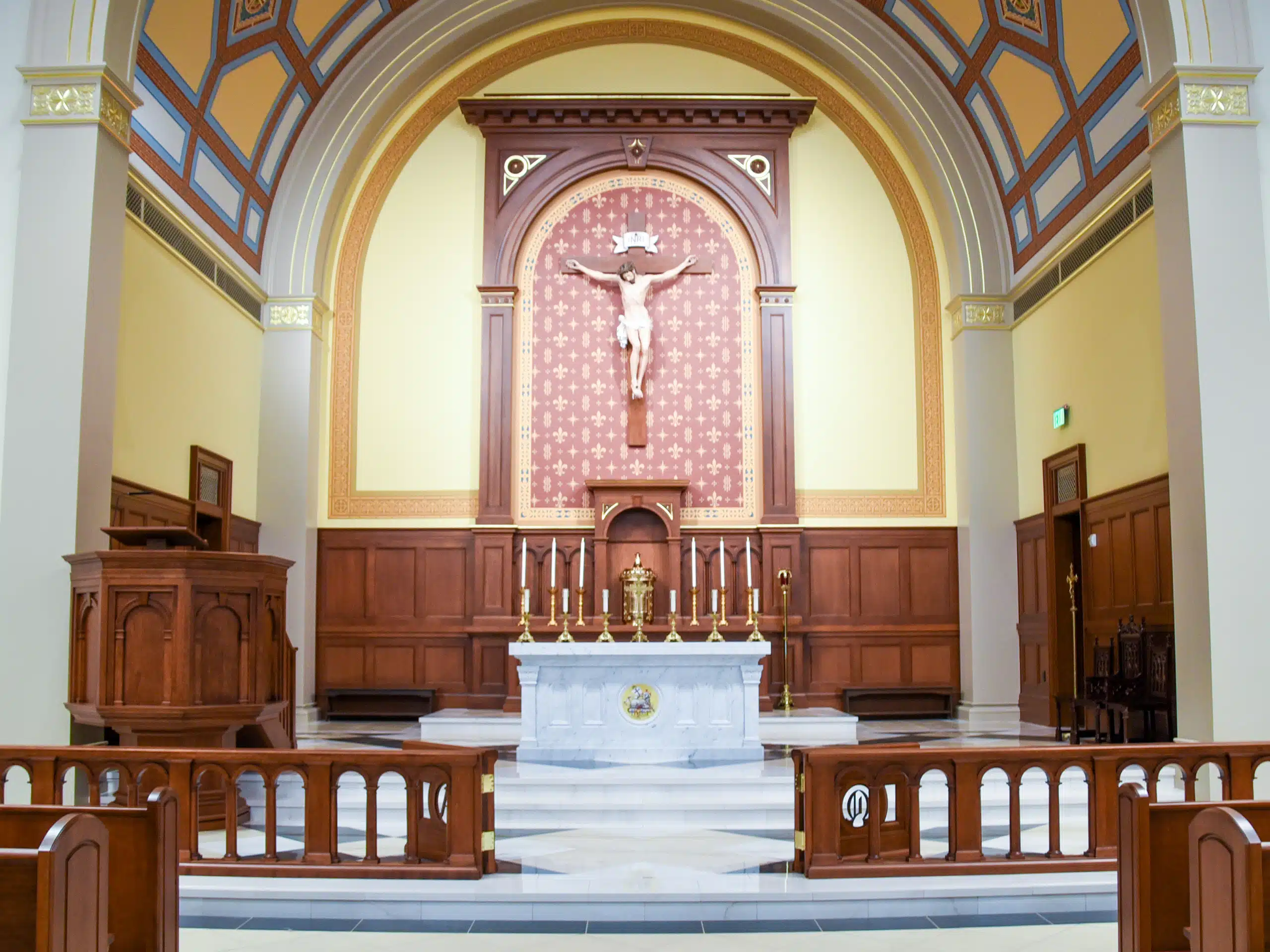
The Catholic Church in the U.S. is undergoing an old-world architectural renaissance and Nicolas Charbonneau wants to make sure it continues.
“Here in the states, we’ve thrown out a lot, literally in the dumpster,” said Charbonneau “I wanted to be part of that revival of making inspiring places where the truths of the Catholic Church were made evident through art and architecture.”
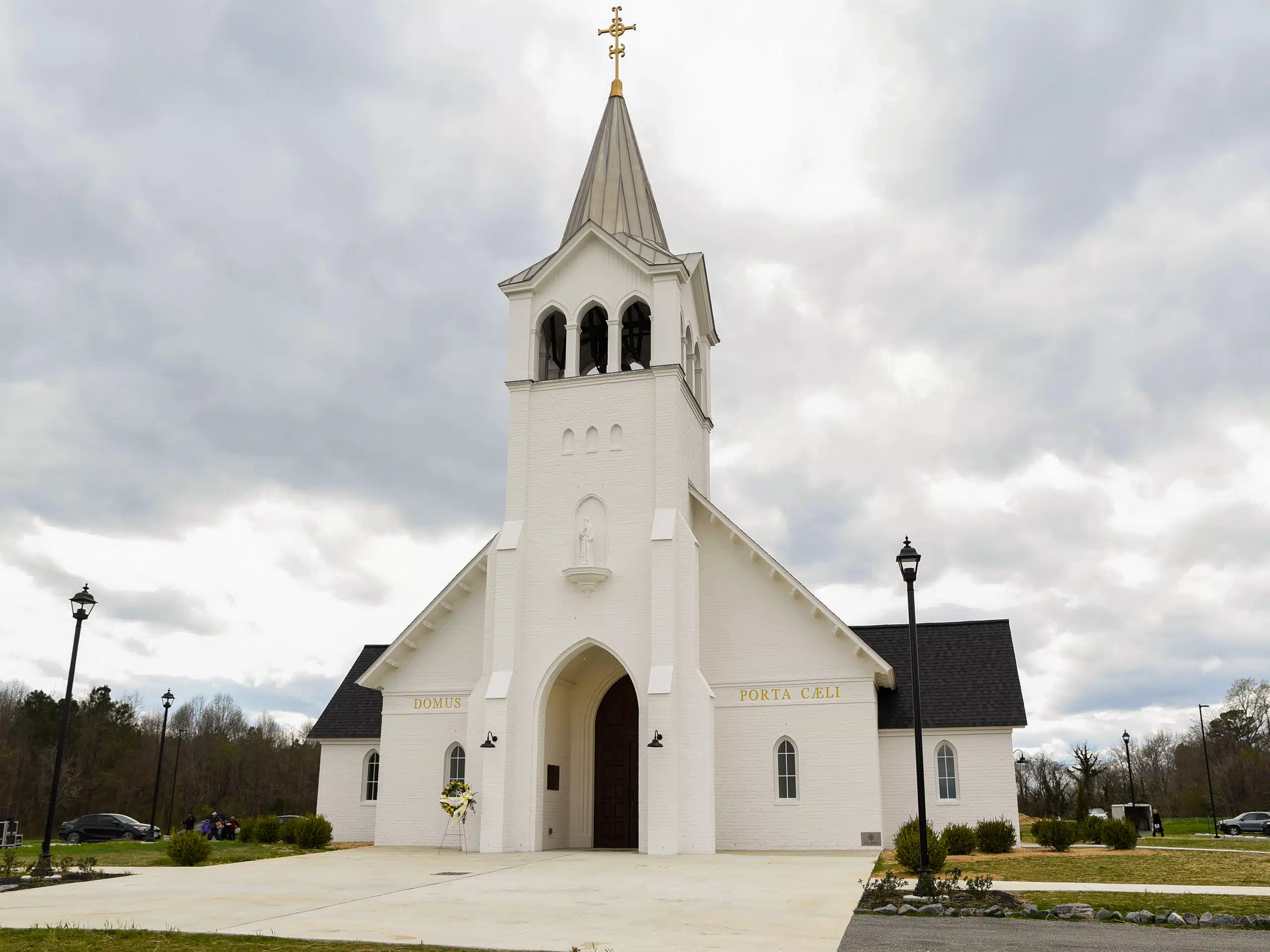
Charbonneau is the award-winning director of Harrison Design’s Sacred Architecture Studio, based in Washington. His projects in the diocese include the design of two new church buildings — St. Ambrose in Annandale, completed in 2023, and St. Paul Mission in Hague, completed in 2022. He also designed the recently finished tympanums (engravings over the front entrances) at St. Rita Church in Alexandria.
All are made to stand the test of time. “It’s founded on principles that align with the teaching of the Catholic Church,” said Charbonneau. “The world is ordered so that there’s a harmony to everything. And we’ve been designed to know that there should be an ordering to what we do. A lot of modern architecture flies in the face of that.”
Architecture is art, and according to Charbonneau, sacred architecture recognizes that the design of a church is always communicating something. It’s similar to the way God communicates in nature.
“Bilateral symmetry is the way that God designs,” said Charbonneau. “You look at any mammal and it’s got a line down the center, and all the important stuff is on that central axis. The renaissance architects were showing that the cruciform church is symbolic of the crucified Christ. You’ve got the head, which is the sanctuary, and what’s going on in the sanctuary is the source and the summit of our faith. You know when you walk in that important things are going on there. That prominence needs to be made manifest via architecture.”
It all sounds like highfalutin stuff for a self-described blue-collar guy from the mill town of Spencer, Mass. Charbonneau, a parishioner of St. John the Baptist Church in Front Royal, was floundering in his faith in 1998 when he signed up to study philosophy in Rome through the University of Dallas. He had no idea his life was about to change when he took a class trip to Venice.
“We were in St. Mark’s Square, early in the morning, and we took a water taxi to San Giorgio Maggiore Church. It has this beautiful white facade, and the professor was explaining how the same proportions that make beautiful and harmonious classical music were used by classical architects to arrange the facades. And it was just one of those moments — the 1-to-2 proportion, the 2-to-3 — these are the things that make harmony in music and make harmonious architecture. I was hooked.”
Charbonneau gets excited talking about the connection between beautiful architecture and evangelization. “I want the experience that I had in Europe to be the experience that people have going into new churches,” he said. “I think part of the cause of me falling away from the church was the iconoclasm (the removal of sacred art) that had been going on for decades.”
The architectural movement that Charbonneau is promoting and the evangelism that it fosters is having an impact in the diocese.
“The parish church is the very center and heart of the parish, for it is where God calls his people to come and hear his word and receive his sacraments,” said Father Andrew J. Fisher, pastor of St. Ambrose. “Nic Charbonneau helped us design a new church that is sacred, beautiful, catechetical, and in continuity with the church’s liturgical rites and history. At the same time, it is built in a way that is welcoming to people with special needs, families and children.”
It took a trip to Europe to awaken Charbonneau to the glory of God as revealed in sacred architecture, but now the U.S. is one of the few places in the world where traditional church building is flourishing.
“We work with artisans in Germany, Italy and Spain, and it’s interesting that 99 percent of their business is here in the United States,” he said. “They’re not doing it in their countries. They’re tearing down churches or using them for something else. There’s something very special going on here.”