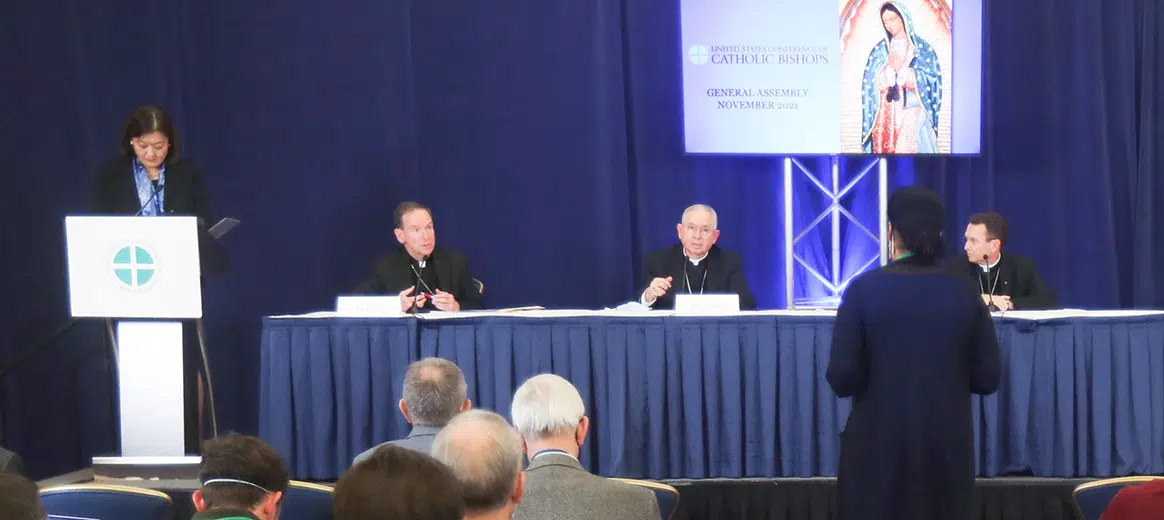
The U.S. bishops approved the text of a new teaching
document on the Eucharist during their fall general meeting in Baltimore Nov.
15-18. This general meeting concluded Bishop Michael F. Burbidge’s term as
chairman of the communications committee. Bishop Burbidge characterized the
document, titled “The Mystery of the Eucharist in the Life of the Church,” as
just one part of a larger initiative to rekindle a firm belief in the real
presence of Christ in the Eucharist.
Earlier this year at the USCCB spring meeting, which took
place over video conferencing, the bishops had a “feisty but respectful” debate
about the possibility of a Eucharistic document, said Bishop Burbidge during
the “Walk Humbly Podcast” Nov. 19.
“One of the things that came out of the June meeting was, we
need more time,” he said. “For the first time since I’ve been a bishop, we
scheduled regional meetings in the summer where 30 or so bishops continued to
speak on the document, to offer suggestions and amendments. So all the bishops
were very engaged in this process.”
The final version was approved by a vote of 222 to 8. One
reason for the document was public opinion polling that asserted that most
Catholics do not believe in the real presence, said Bishop Burbidge. Though the
bishops are commissioning their own poll to learn more, Bishop Burbidge noted
the diocesan Mass count numbers reveal that less than a third of registered
parishioners attend Sunday Mass each week, a sign that perhaps many do not believe
in the real presence. From 2017 to 2019, average weekend Mass attendance in the
diocese decreased by 5.5 percent. Mass count numbers for 2021 are still
pending.
“If people believed and embraced fully that the gift of the
holy Eucharist is truly and really the very body and blood of Jesus Christ,
then all of us would want to be at Mass, all of us would want to be able to
receive this most precious gift,” he said. “It’s our hope that during this
Eucharistic year in our diocese, along with the national Eucharistic revival,
that we reaffirm and reignite in people the awareness that within the Blessed
Sacrament, within the holy Eucharist is the body and blood, soul and divinity
of Jesus Christ, the source of our strength, the source of our consolation. If
we ignite that belief, then we’re going to see our churches filled.”
While there was speculation that the document would call out
Catholic politicians who publicly disagree with church teachings, the document
instead calls all to examine their consciences before receiving Communion. “To
receive the Body and Blood of Christ while in a state of mortal sin represents
a contradiction,” it said. “The person who, by his or her own action, has
broken communion with Christ and his Church but receives the Blessed Sacrament,
acts incoherently, both claiming and rejecting communion at the same time.”
The document continues, citing St. John Paul II, “The
judgment of one’s state of grace obviously belongs only to the person involved,
since it is a question of examining one’s conscience. However, in cases of
outward conduct which is seriously, clearly and steadfastly contrary to the
moral norm, the Church, in her pastoral concern for the good order of the
community and out of respect for the sacrament, cannot fail to feel directly
involved. The Code of Canon Law refers to this situation of a manifest lack of
proper moral disposition when it states that those who ‘obstinately persist in
manifest grave sin’ are not to be admitted to Eucharistic communion.”
The document also cited the teachings of the saints and
other holy people who spoke about their reverence and love for the Eucharist,
including Blessed Carlo Acutis, who was quoted as saying, “The Eucharist is my
highway to heaven.”
The document concluded, “Let us all ask the Lord to call us
into a time of Eucharistic renewal, a time of prayer and reflection, of acts of
charity and sincere repentance. The Lord is with us in the Eucharistic Mystery
celebrated in our parishes and missions, in our beautiful cathedrals and in our
poorest chapels. He is present and he draws near to us, so that we can draw
nearer to him.”