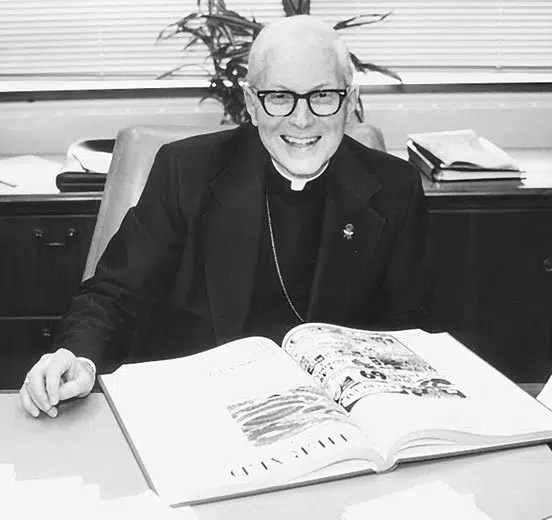
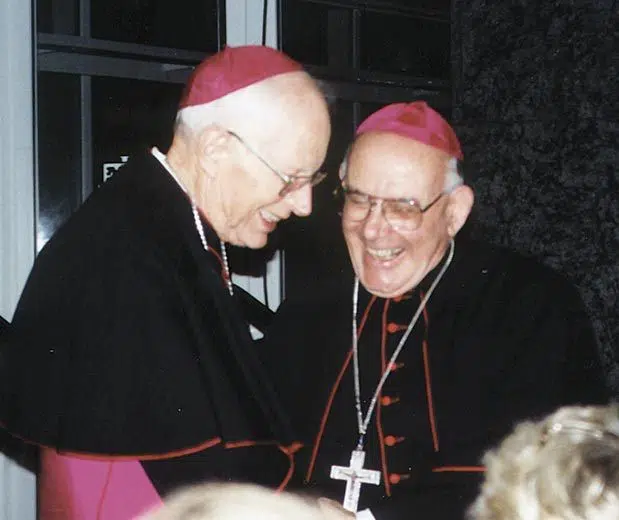
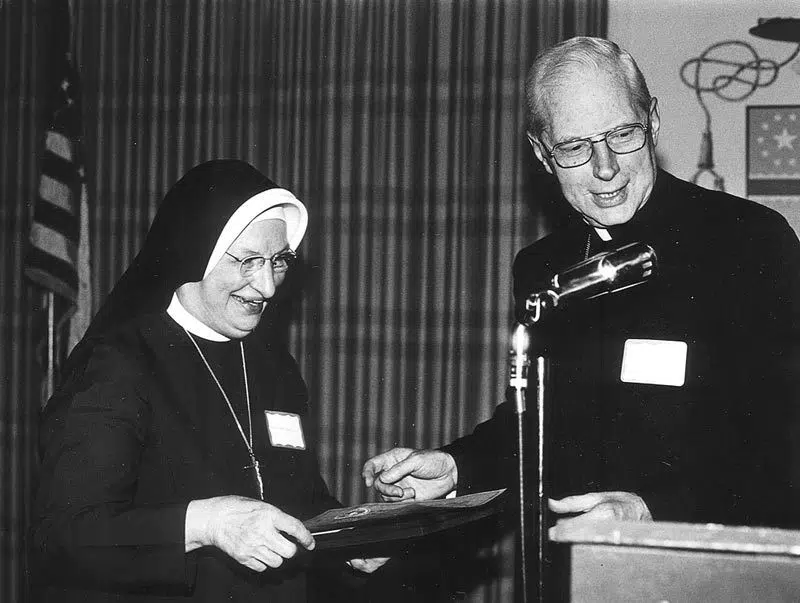
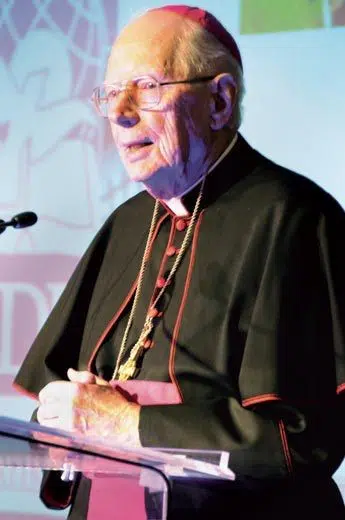
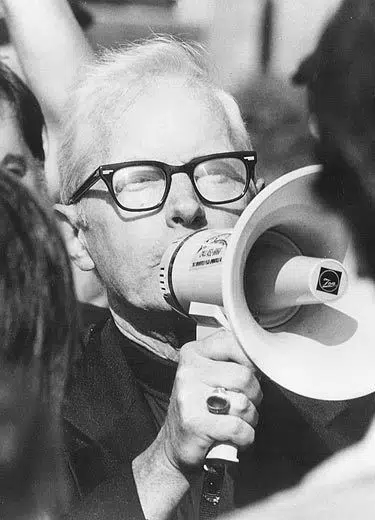
Arlington’s founding bishop, Thomas J. Welsh, died Feb. 19
after a brief illness, thus closing a remarkable chapter in
diocesan history. He was 87.
All funeral services will take place at the Cathedral of St.
Catharine of Siena, 18th and Turner Streets in Allentown, Pa.
Memorial Masses were to be celebrated today and Friday at 11
a.m. each day. A vigil service will be held Friday at 7 p.m.
Visitation was to be held today from 5 to 8 p.m., Friday from
3 to 9 p.m. and Saturday from 8 to 10 a.m.
A funeral Mass will be celebrated Saturday at 11 a.m. Burial
will take place at St. Nicholas Cemetery in Weatherly, Pa.
“Keeping his eyes focused on the example of Mary, the Mother
of God, he gave himself totally and used his gifts and
talents unsparingly to restore all things in Christ,”
Arlington Bishop Paul S. Loverde said in a written statement.
“To the vision of steadfast faith and the practice of
pastoral charity, he added his welcoming personality and a
keen sense of humor.
“Now that he has been called to his eternal reward in our
true home, we mourn his earthly passing yet rejoice in his
having attained the goal to which each one of us is destined:
life on high in Christ Jesus Our Lord. … May Bishop
Welsh, our Founding chief pastor, continue to pray for us:
bishop, clergy, religious and laity, as we journey on our own
pilgrimage of faith towards the Vision of the Triune God.”
A memorial Mass for Bishop Welsh will be celebrated March 16
at the Cathedral of St. Thomas More in Arlington at 7:30 p.m.
Allentown Bishop Edward Cullen asked the faithful of his
diocese to “pray for the happy repose of this faithful
servant and devoted bishop.”
“In his 15 years as Bishop of Allentown and during his
retirement, Bishop Welsh served the faithful of this diocese
tirelessly. This deeply spiritual bishop was an ardent
supporter of Catholic education and a strong advocate for the
unborn.”
Pennsylvania to Virginia and back
Bishop Welsh’s installation in Arlington on Aug. 13, 1974,
began a historic era for the Catholic Church that covers 21
counties in Northern Virginia. The diocese at the time
consisted of 136,000 Catholics in 49 parishes and seven
missions. Those numbers have changed dramatically during the
past 35 years. Arlington now has more than 410,000 Catholics,
68 parishes and seven missions.
Bishop Welsh was an auxiliary bishop in Philadelphia and
rector of St. Charles Borromeo Seminary in Wynnewood, Pa., on
June 4, 1974, when Pope Paul VI announced that the Richmond
Diocese, one of the oldest in the country, would be split to
form the new Arlington Diocese. St. Thomas More Church would
serve as its cathedral.
Msgr. Richard J. Burke, pastor of St. Thomas More at the
time, served as chairman of the installation committee. Msgr.
Paul V. Heller, pastor of St. James Parish in Falls Church,
read the papal bull, which outlined the boundaries of the new
diocese. Concelebrants at the Aug. 13 installation Mass
included the late Archbishop Jean Jadot, apostolic delegate,
former Baltimore Archbishop William Borders and the late
Philadelphia Cardinal John Krol.
Thomas Welsh was born Dec. 20, 1921, in Weatherly, Pa., in
what is now the Allentown Diocese. He was educated at St.
Charles Borromeo Seminary and received his doctorate in canon
law at Catholic University in Washington. He was ordained a
priest for the Philadelphia Archdiocese on May 30, 1946. He
served the archdiocese in a variety of roles, including
parish priest, high school teacher, retreat worker, Tribunal
judge and seminary rector. He was ordained auxiliary bishop
of Philadelphia April 2, 1970.
After more than eight years in Arlington, Bishop Welsh was
appointed the second bishop of Allentown on Feb. 8, 1983, and
installed March 21, 1983. He retired from Allentown in
December 1997.
Laying a firm foundation
Much of the success Arlington enjoys today is the direct
result of the strong foundation established by Bishop Welsh.
He welcomed women religious into the diocese with open arms,
including the Poor Clares, the Daughters of St. Paul, the
Vocation Sisters from England, the Dominican Sisters of
Nashville and Our Lady’s Missionaries of the Eucharist.
He recognized the need to reach out to both Hispanic and
Vietnamese immigrants who flocked to the Washington area in
the mid-1970s. The Vietnam War was about to end, and many
South Vietnamese immigrants were forced to leave their
homeland and settled in the Washington area.
The Office of Migration and Refugee Services was established
in 1975 after Bishop Welsh was contacted by the U.S. Catholic
Conference, now the U.S. Conference of Catholic Bishops.
Deacon Daniel Resendes was appointed its first director. By
the end of 1975, more than 2,300 refugees had settled in the
diocese. In 1979, Bishop Welsh established Holy Martyrs of
Vietnam Parish in Arlington to minister directly to the
Vietnamese community.
A strong proponent of the Catholic press, Bishop Welsh
established the Arlington Catholic Herald in August
1975 and hired Charles W. Carruth as its founding editor. The
first issue of the new paper rolled off the presses in
January 1976.
He approved the establishment of Christendom College in 1977
and approved the purchase of the building and property that
now houses Paul VI Catholic High School in Fairfax.
As a way of mobilizing the laity, the bishop established the
Brent Society, an organization of Catholic lay professionals
that took its name from the Brent family, the first permanent
Catholic settlers in Virginia. The society’s distinguished
list of presidents over the years included Bill Grant, Mary
Meade and Gordon Hermes.
Bishop Welsh established the Family Life Bureau (now the
Family Life Office) in 1977 under the direction of Father
Franklyn McAfee. The bureau organized diocesan pro-life
activities, which included the March for Life and special
Masses and prayer vigils against abortion. The bishop
remained throughout his life a strong spokesperson for life
issues.
A lasting legacy
While in Arlington, Bishop Welsh established six new
parishes: St. Stephen the Martyr in Middleburg; St. Elizabeth
Ann Seton in Lake Ridge; Our Lady of the Blue Ridge in
Madison; St. Catherine of Siena in Great Falls; St. John
Neumann in Reston; and Holy Martyrs of Vietnam.
He dedicated 11 new churches and several more were near
completion or in the planning stages when he left Arlington.
In fact, Bishop John R. Keating’s first official act after
his installation as the second bishop of Arlington in 1983
was the dedication of Precious Blood Church in Culpeper.
“Msgr. (James) McMurtrie always used to say to me that Bishop
Welsh would go out and bless your pet rock if you asked him,”
said Father James Gould, pastor of St. Raymond of
Peñafort Parish in Springfield. “He came for
everything. He was always on the road and he drove his old
Volkswagen Rabbit with the diesel engine.
“He lived the three calls of St. Louis de Montfort – to live
a life of holiness, to live a life of service and be prepared
for the spiritual battles that come your way,” Father Gould
said.
Father Robert Avella, pastor of Our Lady of Lourdes Parish in
Arlington, was the first priest ordained for the Arlington
Diocese and the first priest to whom Bishop Welsh had
administered the sacrament of holy orders.
“You can really see God’s hand in sending him to found the
diocese because the foundation of anything is so important,”
Father Avella said. He credited Bishop Welsh with laying a
firm foundation for priestly vocations.
“He had always hoped that our diocese would have so many
priests that he’d be able to help other dioceses in need,”
Father Avella said. “He always had that parish priest
instinct about him.”
Even in retirement, Bishop Welsh continued to be a visible
presence in the diocese due to his involvement with the
Catholic Distance University. Marianne Evans Mount, CDU’s
executive vice president, gives the bishop an enormous amount
of credit for the university’s continued success. Last year
CDU celebrated its silver anniversary. Bishop Welsh’s remarks
at CDU’s annual gala were legendary for their wit and
self-deprecating humor.
“He was really an education bishop,” Mount said. “He believed
in Catholic education at all levels. He thought that for
parents to be systematically studying the Faith in the home
was a wonderful means of renewing family life.”
Mount said Bishop Welsh’s sense of humor and “his love of
life and his love for children and families” were also
hallmarks of his ministry.
“He had a beautiful spirit, he was always doing a lot of
things in the background,” Mount said.
Catholic Herald Staff Writer Stephanie Tracy contributed to
this report.