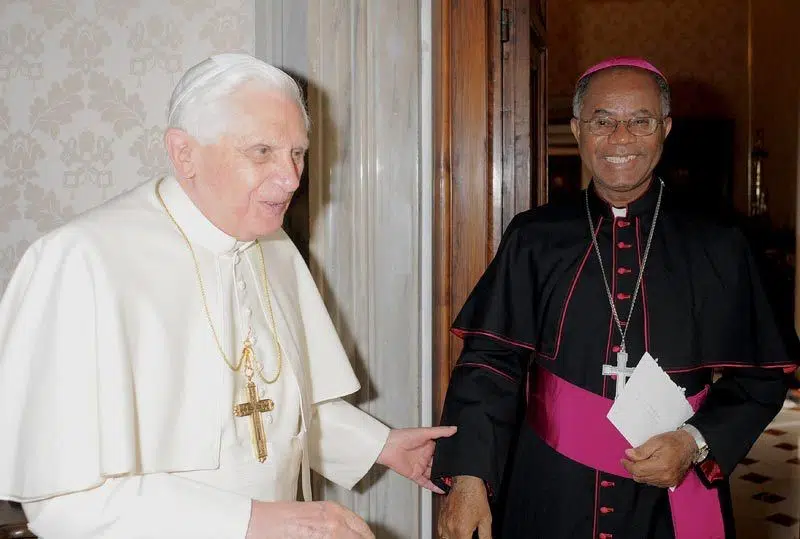
WASHINGTON – Haitian Archbishop Joseph Serge Miot was known
as a humble man who was close to the poor in the Archdiocese
of Port-au-Prince.
Archbishop Miot, 63, was among tens of thousands of Haitians
who died in the Jan. 12 earthquake.
For years he served as president of the Haitian bishops’
justice and peace commission, and he often spoke of the need
to help the citizens of the Western Hemisphere’s
most-impoverished nation.
“The misery is so great,” Archbishop Miot told Catholic News
Service in New York in May 1998. “Things have never been as
bad as they are now. People who could not make a living in
the rural areas have moved to the cities, and they are piling
up in the slums.”
In a Jan. 14 e-mail to Catholic News Service, Archbishop
Bernardito Auza, papal nuncio to Haiti, said the archbishop
“was hurled from the balcony outside his room while he was
waiting for another person on their way to a ceremony. The
force of the earthquake threw him headfirst off the balcony
and he died, it seems, from the impact.”
Because there was no electricity in the city, church
officials took Archbishop Miot’s body to the coastal city of
St. Marc, said the nuncio. He said he asked that the body be
buried immediately, which is not the normal Haitian
tradition.
Haitian Holy Cross Father Rodolphe Arty, associate pastor of
St. Thomas the Apostle Parish in Naperville, Ill., described
Archbishop Miot as “a man of prayer” with a “great devotion
to the Blessed Mother.”
Father Arty, who said the archbishop taught him philosophy at
the major seminary in Port-au-Prince, told CNS by telephone
that his friend would welcome anyone into his home.
He was “humble” and “very close to poor people in
Port-au-Prince,” said Father Arty, a former provincial of the
Holy Cross Fathers in Haiti. The priest, who has been at the
Illinois parish for three months, also said he crossed paths
with the archbishop at youth and pastoral ministries
meetings.
Thomas Quigley, former adviser for Latin American affairs for
the U.S. bishops’ conference, said he considered the late
archbishop a friend. Archbishop Miot often visited the U.S.
bishops’ headquarters in his role as general secretary of the
Haitian bishops’ conference.
Quigley said Archbishop Miot was “a modest man” and “very
soft-spoken.”
“He was such a wonderful man,” said Liz McDermott of Le
Claire, Iowa. “We lost a wonderful soul, truly a man of God.
It’s just heartbreaking.”
As a volunteer with ServeHAITI, she has made numerous mission
trips to the medical clinic the organization operates in
Grand Bois, about 60 miles from Port-au-Prince. Archbishop
Miot even attended a Haitian fundraiser at Our Lady of the
River Parish in Le Claire in October 2008 and, while he was
there, he concelebrated the funeral of the parish’s pastor,
Msgr. Leo Feeney.
Joseph Serge Miot was born in Jeremie, Haiti, Nov. 23, 1946.
He was ordained July 4, 1975.
As a priest, he taught and served as rector at the seminary
in Port-au-Prince until he became rector of the newly
established University of Notre Dame of Haiti in 1996.
In July 1997, Pope John Paul II named him coadjutor
archbishop of Port-au-Prince in an effort to resolve a
difficult situation that arose after a failed presidential
coup in 1991. Many city residents held Port-au-Prince
Archbishop Francois-Wolff Ligonde responsible for encouraging
the coup, and crowds burned his residence as well as the
headquarters of the Haitian bishops’ conference, a historic
church that formerly served as the cathedral and the Vatican
nunciature.
Archbishop Miot was administratively in charge of the
archdiocese as coadjutor; he succeeded as archbishop March 1,
2008.
In 2005, he suspended a popular imprisoned priest, Father
Gerard Jean-Juste, for defying the hierarchy’s orders and
presenting his credentials to be a presidential candidate in
the November elections. The priest later traveled to the
United States, and in May 2009 he died of complications from
a stroke and a lung problem in a Miami hospital.
Contributing to this story were Carol Glatz in Rome and Barb
Arland-Fye in Davenport, Iowa.