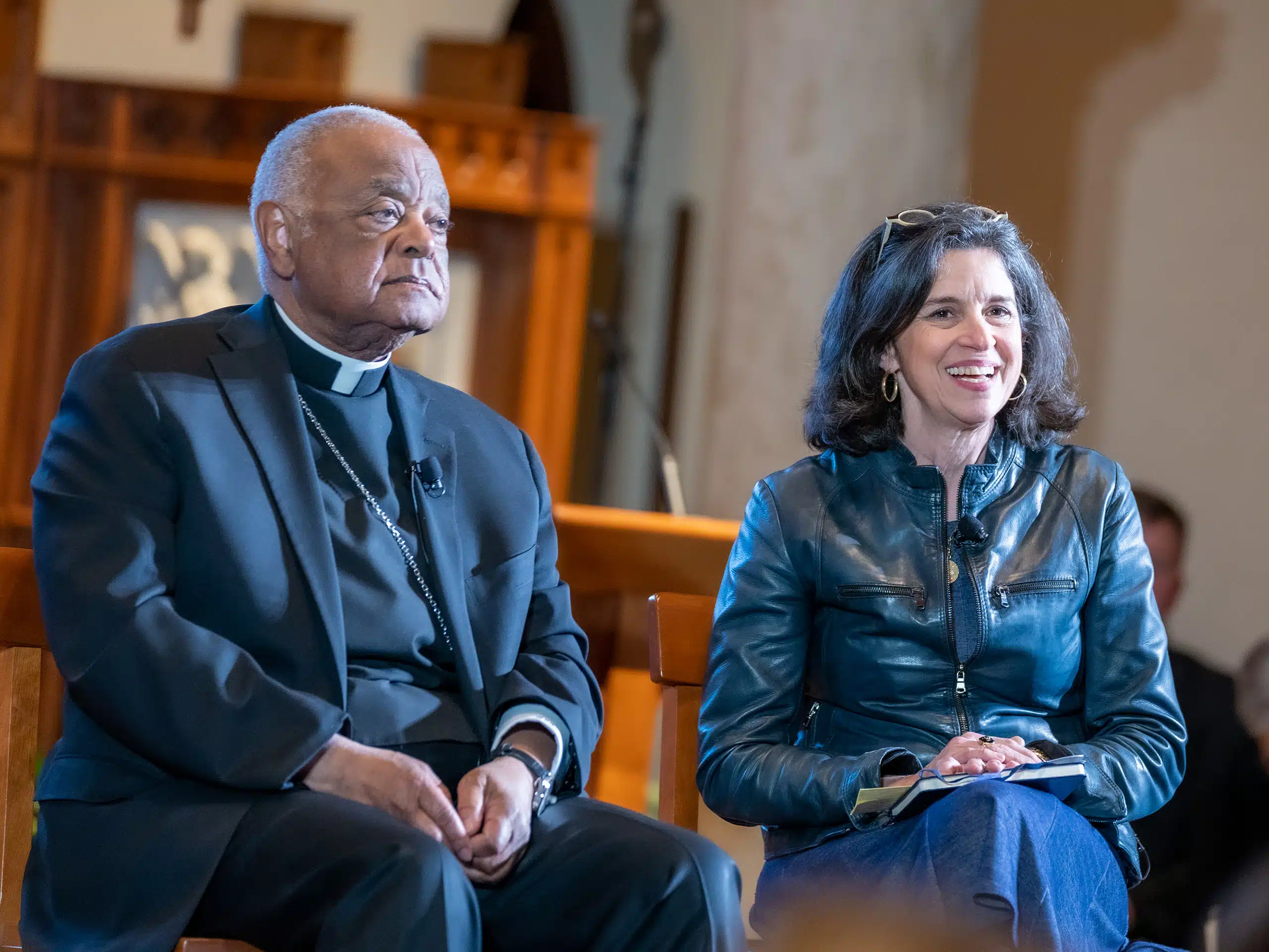
In a panel marking 10 years of Georgetown University’s Initiative on Catholic Social Thought and Public Life, Washington Cardinal Wilton D. Gregory reminded the audience of the groundbreaking programs that have been the hallmark of the initiative’s regular dialogues.
As panelists Feb. 28 in turn considered how Pope Francis has shaped the Catholic Church over those same 10 years, Cardinal Gregory said that with his approachable writing style, use of common language and humble manners, the pope has “made conversation with ordinary people accessible.”
Cardinal Gregory was joined for the program by Sister Norma Pimentel, a member of the Missionaries of Jesus who is executive director of Catholic Charities of the Rio Grande Valley; E.J. Dionne, a columnist for The Washington Post, senior fellow at the Brookings Institution and professor in Georgetown’s McCourt School of Public Policy; and Helen Alvaré, professor at George Mason University’s Scalia School of Law and a member of the Vatican Dicastery for Laity, Family and Life. Each spoke about how Pope Francis has influenced the church and the challenges facing both the pontiff and its people.
Georgetown University President John J. DeGioia, the initiative’s director Kim Daniels and the initiative’s founder John Carr also provided perspectives on the initiative and Pope Francis.
Continuing his comments, Cardinal Gregory said Pope Francis has “made it uncomfortable to take great comfort in any one dimension of the church’s social teaching.” Members of the Catholic Church are clearly quite polarized over a range of issues, he said. “There are so many examples of how we find it difficult to talk to each other.”
Yet, Pope Francis “makes it possible for us to say, ‘If you really want to be a Catholic, you’ve got to embrace the whole of the church’s social teaching. You can’t be comfortable with just the pro-life banner. You can’t be comfortable with just the progressive social teachings. You’ve got to have it all,’ ” the cardinal said.
Pope Francis’s example of how to embrace the range of social teaching challenges the world and the church, he said.
“It’s clear that we’ve got to do something to allow people to speak to each other with civility, honesty and charity and not feel that there are winners or losers. That’s what polarization does: either I win or you win,” Cardinal Gregory said. “I think Francis says, why don’t we both win by understanding the breadth of our Catholic faith and approaching complex issues with a reverential deference to the truth.”
Daniels asked Cardinal Gregory, who served as president of the U.S. Conference of Catholic Bishops 2001-04 during a major sex abuse reckoning for the bishops, to talk about the bishops’ conference. She asked, “What are the ways in which he (Pope Francis) draws bishops together and what are some misunderstandings? What do you think about polarization in the U.S. church?”
Sister Norma, who has been singled out by Pope Francis for her work with immigrants at the Mexican border in Texas, said she is struck by how Pope Francis calls Catholics to “really care, to be inclusive.”
She said, “We have become a church that’s so comfortable,” as people operate in their bubbles of comfort. “And we have left people out.” But Pope Francis calls us “to be one church. And the only way to be one church is to kind of get messed up and dirty … to get out there and bring everybody in. His message of inclusiveness, of encountering the other, is really what we must all do … . He encourages us to be better. To be better Catholics.”
Sister Norma stressed the importance of seeing the humanity in migrants and other people in need, and reaching out to them with love.
Alvaré pointed to the example of Pope Francis in following the lessons of the parable of the Good Samaritan. For Americans, the pope makes some strong demands against radical materialism and individualism common to the United States. “When he asks for accompaniment, it’s not like, for an hour. He’s talking about people who need a long time. And it requires us to change our way of life. You can’t live normally according to our American standards and do what he’s asking us to do,” she said. “When he asks for accompaniment, it’s in a way that demands we change how we’re being. That sticks with me constantly about him.”
Dionne recalled being at the very first of the dialogues hosted by the initiative and lauded the program’s efforts over 10 years.
“It’s been a real blessing for this university and for the country,” Dionne said. “Because Catholic social thought has so many inner balances in it that we desperately need. I found in teaching that so many students know nothing about Catholic social thought … I think bringing this to our students has been extraordinary.” He credited Carr and Daniels with making a difference in closing the gap in what people know of Catholic social teaching, as has Pope Francis.
“So much of what this initiative is about is about Pope Francis,” Dionne said. He recalled that the late political analyst and columnist Mike Gerson said at one of the initiative’s dialogues that “Pope Francis is a troublemaker. I think that is in the tradition of (the late Rep.) John Lewis, who spoke of making good trouble … he is a troublemaker. He challenges all of us.”
Dionne ticked off some of what the pope has done to be a “troublemaker.”
“He attacked the spirit of careerism in the church, called it a form of cancer. He attacked theoretical severity and sterile pessimism and exaggerated doctrinal security. And — here is my very favorite thing about Francis, and maybe we owe it to his translator. But very early in his papacy, Pope Francis condemned being a sourpuss. I want a pope who is against sourpusses.”
Reprinted with permission of the Catholic Standard in Washington.