Creep along Mill Road or else you’ll shoot past it and find
yourself on Interstate 495. Alexandria’s William G. Truesdale
Detention Center – known to local criminals as “the Hilton of
Northern Virginia jails” – is camouflaged among the red brick
of its mixed residential and commercial Old Town neighbors.
But once you see it, the mammoth complex is impossible not to
register.
Built in 1987, the imposing facility known as the Alexandria
jail houses about 400 inmates. These men and women face a
range of local, state and federal charges. Yet, regardless of
past transgressions, all inmates on good behavior have the
option of attending Christian services and participating in
Bible study. Mass, as with all religious services at the
jail, is voluntary, but inmates must be cleared to attend.
Those who do not come sit in their cell or home unit.
Strict regulations mean that getting clearance to visit the
jail for any reason is a tricky task. Even as a journalist on
assignment, the process is complicated. In this case, the
hope was to witness Arlington Bishop Paul S. Loverde
celebrating Mass Dec. 17, in observance of the third week of
Advent.
Once cleared, navigating the jail requires at least one
escort and means braving a series of doors and elevators. At
the end of the labyrinth is the blue and green multipurpose
room, the site of all religious services, including Mass. It
is the same place where the inmates play basketball and
gather for large events.
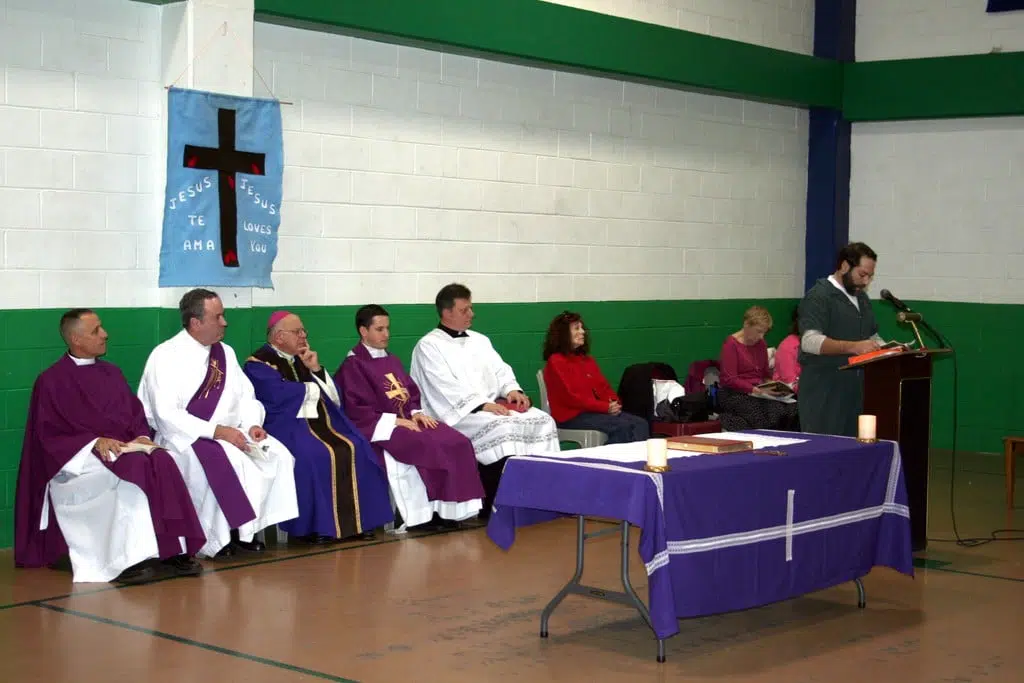
To prepare for the weekly Wednesday Mass, jail staff and
Catholic volunteers set up a table, a podium and about 50
plastic chairs too light to injure anyone if hurled. Four
more chairs are tucked into corners to serve as
confessionals. A blue, black and red banner with a cross and
the words “Jesus loves you” in English and Spanish adorns the
concrete wall. This banner serves as the cross above the
altar.
The program featured a colorful cover, a headshot of the
bishop and fully translated text. The last page included the
news that Pope Francis condemned the death penalty and life
imprisonment – the “hidden death sentence” – when he spoke to
a delegation from the International Association of Penal Law
Oct. 23, 2014.
The pope’s quote, typed in bold, read: “It is impossible to
imagine that states today cannot make use of another means
than capital punishment to defend peoples’ lives from an
unjust aggressor.”
As the priests, deacons and volunteers settled into their
places, inmates in green jumpsuits trickled into the room.
Their sneakers featured Velcro straps but no laces. Every
week, female inmates are brought in last and brought out
first so as not to attract attention from male inmates. Of
the six female inmates who signed up, two attended the Mass.
Bishop Loverde celebrated Mass in English and Spanish to
accommodate a bilingual congregation, as is customary at the
Alexandria jail.
Deputy Sheriff Valarie Wright was one of the staff members
supervising the bishop’s Mass.
“(Religious programming) gives the inmates an outlet,” Wright
said. “Some use it for the purpose it was intended. The large
majority don’t. Some use it as a means to falsely portray
that they’ve morally rehabilitated. But if it’s not in their
heart, they’re still coming back here to jail.”
About half of inmates return to jail within a year of being
released.
Richard Butler III, 33, one of the inmates who attended the
bishop’s Mass, is in jail for a probation violation. Raised a
Protestant, he comes to the Catholic Mass every week.
“I attend all Christian services because I believe in one
God,” said Butler. “I’ve been trying to learn the rosary, but
that’s a lot, so it’s kind of hard.”
Another inmate who attended the Mass, Louis Marelli, 44, who
is there on an undisclosed federal charge, was raised
Catholic. But until a jail volunteer gave him instructions in
2010, he had never recited the rosary.
“When I was saying the prayers, I was at ease,” Marelli said.
“I felt the anxiety start to go away. I felt peaceful and
humble.”
Marelli said he also goes to the jail meditation class, reads
the Bible and listens to Christian radio.
Bill Hall, diocesan prison ministry coordinator at Catholic
Charities, serves what he describes as an “administrative
function,” by providing materials for services and Bible
study throughout the diocese. Currently there are 19 jails
and prisons supported by parish volunteers. Not all have Mass
due to the logistics involved.
After spending 20 years in the Air Force and 15 years as a
consultant, Hall retired. His friend introduced him to
Catholic Charities, allowing him to volunteer for car
ministry, where he repaired old cars for families in need,
before moving to prison ministry for Kairos, an international
prison ministry.
When people ask Hall if the work is “scary,” he says no and
encourages them to volunteer.
“These are people who’ve made mistakes, but a lot of them are
very well-versed in Christianity,” said Hall. “At times in
your life, you need a spiritual charge to your battery. When
I need a charge, I go to prison. Jail allows us to have very
spiritual conversations that people on the outside don’t
have.”
Hall’s friend, Dave Druitt, who lives in Springfield, also
volunteers for Kairos Prison Ministry, among other jail
programs throughout the diocese. A Vietnam War veteran, he
worked on a national security team for 25 years when he
couldn’t go to work anymore because his post-traumatic stress
disorder suddenly flared up. He began barricading himself in
his basement and garage.
“I suffered from soul sickness and the absence of the feeling
of God’s presence,” said Druitt.
He recognized the need for change. Raised Episcopalian,
Druitt converted to Catholicism and began volunteering in
prison ministry.
“Volunteering at the jail helped me develop self-esteem,
faith and contact with God,” said Druitt.
It also helped him realize that “we are all broken. We all
have shame or human error.”
He wanted to give inmates a second chance. Three years ago,
Druitt started a painting business called Dreamcoat, where he
employs ex-convicts to paint commercial and residential
properties.
“Some of (these men) are damaged. They can’t develop a
personal relationship with God,” said Druitt. “Many inmates
get out of prison and have nowhere to go.”
Druitt invites his painters to attend Mass with him or join
him at a men’s prayer group in their spare time. It is always
a voluntary activity, not a condition of employment. Many of
the contractors choose to join him.
During a typical week in November at the Alexandria jail, 45
attended Catholic Mass and 54 inmates participated in Bible
study. The most popular service is Christian worship,
followed by Spanish-language Baptist worship.
The jails also offer options outside of Christian worship.
One of the most popular classes at the Alexandria jail is
weekly meditation led by Carolyn Stachowski of Insight
Meditation Community of Washington.
“I encourage a kind of alert yet relaxed frame of mind,” said
Stachowski. “If we are taking the time to look inside, we are
going to be on the spiritual path. Meditation has a lot of
commonality with all religions.”
Jewish services and kosher food are available upon request,
with services provided during holidays.
In a statement, Sheriff Dana Lawhorne said, “The religious
services and classes offered to inmates are incredibly
beneficial. They allow inmates who already had strong faith
to remain connected to their religion, which is especially
important during a difficult time in their lives. These
programs also benefit inmates who may not have been
particularly religious before but who now seek spiritual
guidance as they try to improve their lives.”
Lenora Murphy, the volunteer coordinator at the Alexandria
jail, said the dedication of the Christian volunteers
impresses her.
“Christian volunteers restore worship. They stand by the
inmates and sing. They point out Scripture. They pray,” said
Murphy. “They help normalize what inmates do when they’re on
the outside.”
Find out more
To learn more about the diocesan Catholic Charities prison
ministry, go to ccda.net/programs_prison.php.
For more information about Dreamcoat, call 703/626-6516.
Stoddard can be reached at [email protected].