ST. CLEMENT’S ISLAND, Md. — On their four-month ocean voyage from
England to the new Maryland colony nearly 400 years ago, the approximately 150
men and women on board boats named the Ark and the Dove endured stormy seas and
the risk of being ambushed by pirates.
And when their ships sailed through the Potomac River and made
landfall March 25, 1634, on an island they named after St. Clement, the patron
saint of mariners, they came ashore offering prayers of thanksgiving as Jesuit
Father Andrew White celebrated the first Mass in the English-speaking colonies.
Lord Baltimore, who was Catholic, established the Maryland colony
as a haven for religious toleration, and historians now regard Maryland as the
birthplace of religious freedom in the United States.
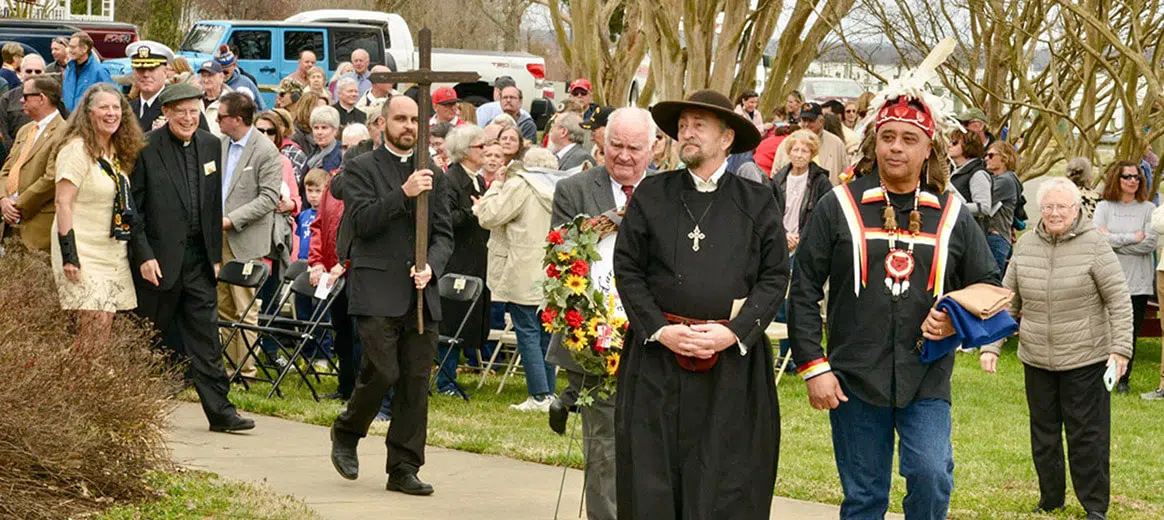
That heritage was celebrated in a special way this March 25 on
the annual Maryland Day, as a treasured artifact of early U.S. Catholic history
— a 17th-century iron cross believed to have been hammered together by a
blacksmith on board either the Ark or the Dove — returned to St. Clement’s
Island in Southern Maryland.
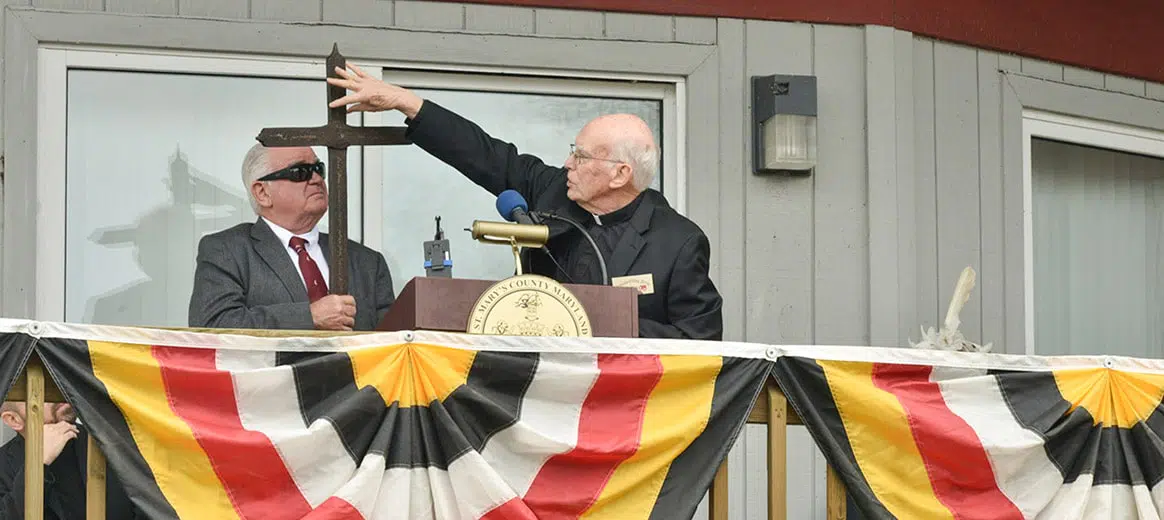
“It’s the first cross brought to our part of the New
World,” said Jesuit Father G. Ronald Murphy, who brought the cross with
him from Georgetown University and displayed it outside the St. Clement’s
Island Museum as he gave the keynote address at a special Maryland Day
gathering there.
The 80-year-old professor emeritus of German literature at
Georgetown told the story of how he rediscovered that cross in the university’s
archives in 1989 after it had been lost to history.
At that time, he was serving as the superior of the Jesuit
community at Georgetown, and when visiting a historic parish founded by his
order on Maryland’s Eastern Shore, he saw a cross described as a replica of the first cross brought to Maryland
by the original English colonists, with the original said to be at Georgetown
University, the nation’s first Catholic university, which was founded in 1789
and continues to be sponsored today by the Society of Jesus.
His curiosity about the cross led him to search through the
university’s artifacts, which he said included old chalices and liturgical
vestments, and even drums, muskets and sabers from the Civil War.
“When (Georgetown) students came back from the war, they
were asked by the priests to turn in their weapons,” Father Murphy said,
laughing.
The Jesuit priest said he was about to give up his search, when
he wanted to take a look at a wall filled with swords, and he tripped on
something, and there on the floor, he spied a cross on a wooden palette.
“I did stumble across it. … That’s how it got
reclaimed,” he said.
The priest spoke to a standing-room crowd gathered outside the
St. Clement’s Island Museum at Colton’s Point, within view of the historic island
about one-half mile away across the water.
“It really is a beautiful piece,” Father Murphy said.
At times during his address, he held aloft the simple cross, which is 4 feet
tall, 2 feet wide and weighs about 24 pounds. It was hammer-welded from strips
of iron, probably from ballast on one of the ships. The priest noted the
inscription on its vertical bar, which reads, “This cross is said to have
been brought by the first settlers from England to St. Mary’s.”
After landing at St. Clement’s Island, the colonists — who
included Catholics and other Christians — established their settlement at
nearby St. Mary’s City, which became Maryland’s first capital. A reconstructed
Brick Chapel at Historic St. Mary’s City based on a 1667 building stands today
as a monument to Maryland’s pioneering role in safeguarding religious liberty,
which would later be enshrined as the first freedom in the U.S. Constitution’s
Bill of Rights.
Since it was rediscovered, that iron cross has been displayed at
Georgetown University’s Dahlgren Chapel, and from mid-2017 to 2018, it was part
of an exhibit on “Religion in Early America” at the Smithsonian’s
National Museum of American History.
The cross also has been part of a modern historic event, when it
was displayed on the ambo that Pope Francis preached from in 2015 outside the
Basilica of the National Shrine of the Immaculate Conception in Washington,
when the pontiff presided at the first sainthood ceremony ever held in the
United States — the canonization Mass for St. Junipero Serra, the famous
18th-century Spanish Franciscan who established missions along California’s
coast.
Father Murphy opened his talk by noting, “I have heard about
St. Clement’s Island all my life, and now I’m looking at it.” He added,
“It’s not very big.”
Erosion has caused the island to diminish to 40 acres, about
one-10th of its size when the English colonists landed there. Now visitors can
take water taxis to visit St. Clement’s Island State Park.
Later as he finished his address after he recounted the cross’s
rediscovery and its importance, the priest said, “That’s the story of
Maryland’s first cross.”
Crosses have marked the history of St. Clement’s Island for
nearly four centuries. After the colonists participated in the first Mass
there, they erected a large wooden cross hewn from a tree there, and knelt down
and prayed the Litany of the Cross. In 1934 to mark the 300th anniversary of
Maryland, a 40-foot high cross built of oil barrels covered in white stucco was
erected on the island and still stands there today.
About 40 students from the chorus at Father Andrew White, S.J.
School in Leonardtown sang the state song, “Maryland, My Maryland” to
help open the ceremony, and Sarah Skane, a student from St. Mary’s Ryken High
School in Leonardtown, sang the national anthem. Father Samuel Plummer, the
administrator of nearby Holy Angels Church in Avenue and Sacred Heart Church in
Bushwood, offered the invocation and benediction.
Beforehand, Heather Francisco, the principal of Father Andrew
White, S.J. School, said their school community is proud to be named for that
pioneer priest, and she noted the significance that the colonists’ landing in
Maryland happened on the feast of the Annunciation, commemorating when Mary
said “yes” to being the mother of God’s son.
“Jesus won our freedom,” she said, praising the
colonists for first participating in a Mass when they landed in their newfound
haven for religious freedom. “It speaks to the fact their faith was strong
and something they relied on, as I imagine they left everything they knew to
come here in the interest of worshipping God in their own way.”
Zimmermann is editor of the Catholic Standard, newspaper
of the Archdiocese of Washington.