WASHINGTON – Near the Crypt Church of the Basilica of the
National Shrine of the Immaculate Conception, in the Hall of
American Saints, across from the papal tiara and the statue
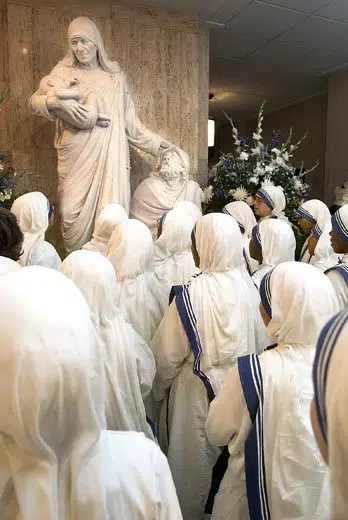
of St. Rose Philippine Duchesne stands a gleaming new white
statue of Blessed Teresa of Calcutta.
With a smile on her face, Mother Teresa holds a baby in one
arm and has her other hand placed lovingly on the head of a
poor man crouched at her feet.
The statue – the newest addition to the national shrine in
Washington – was the gift of an anonymous donor. It was made
in Italy and the planning for it has been in the works for
more than a year, according to Msgr. Walter Rossi, basilica
rector.
A special dedication Mass was held Sept. 13 in the basilica’s
upper church, followed by the dedication of the statue
downstairs. A large portrait of Mother Teresa was displayed
at the front of the church.
Numerous members of the Missionaries of Charity, the
religious order founded by Mother Teresa in Calcutta, India,
filled the front pews of the basilica for the dedication
Mass, dressed in the order’s traditional white sari with the
blue border.
In his homily at the Mass, Bishop Michael J. Bransfield of
Wheeling-Charleston, W.Va., said “such a cross section of our
country, a real mosaic of the Catholic faith” had come to the
dedication.
Bishop Bransfield was the rector of the national shrine from
1986-2005 and was present at many of Mother Teresa’s visits
to the shrine. “Without a doubt, among the most significant
moments of that service were the times that Mother Teresa
would visit the shrine,” he said.
Mother Teresa had a “phenomenal effect on so many in our
country,” Bishop Bransfield said. The bishop noted how Mother
Teresa found her life’s work, serving the poorest of the
poor. On Sept. 10, 1946, she boarded a train to Darjeeling,
India, for a retreat. It was on that train that God gave her
the “‘call within the call,’ to satiate the thirst of Jesus
by serving him in the poorest of the poor,” the bishop said.
Bishop Bransfield said that same vision Mother Teresa had is
seen today “in every Missionary of Charity chapel throughout
the world where the crucifix is powerfully displayed in the
sanctuary and the words, ‘I thirst,’ are written next to it
on the sanctuary wall.” The bishop said Mother Teresa’s
answer to God’s call reflects the truth of the Gospel which
manifests the idea that “faith in Jesus is linked to doing
something for others.”
He told members of the congregation that they must reach out
to others like Mother Teresa did. “Our faith in the Lord
should lead us to care for those around us, especially the
poor and those who have no one else to care for them,” he
said. These “works of mercy … are essential in the life of
the church,” he said.
In an interview with the Catholic Standard, Washington
archdiocesan newspaper, Sandra McMurtrie, a good friend of
Mother Teresa’s who was a lector at the Mass, said, “Mother
was such a great part of our lives. She was just
magnificent.”
While accompanying Mother Teresa on a trip to Mexico,
McMurtrie met a little girl with Down syndrome at a home
operated by the Missionaries of Charity and adopted her. In
2003 at the Vatican, her daughter, Maria Teresa Guadalupe
McMurtrie, helped bring up the offertory gifts at the
beatification Mass for Blessed Teresa of Calcutta, who was
her godmother.
Patrick Arozario was born in Calcutta and attended Mother
Teresa’s funeral there. At the dedication ceremony for her
statue, he said he felt “blessed to be part of this
ceremony.” Now a member of St. Camillus Parish in Silver
Spring, Md., Arozario said he often returns to Calcutta and
visits the late nun’s tomb.
Bala Thirumala Reddy, who is also originally from India and
now lives in Morgantown, W.Va., attended the ceremony with 12
of his family members. “We are proud that (Mother Teresa)
worked for the Indian people and the poor,” he said.
Thirumala Reddy noted that Mother Teresa reached out to all
people, regardless of their religious affiliation. He said
the statue is a symbol for her life, because she helped both
the young and the elderly.