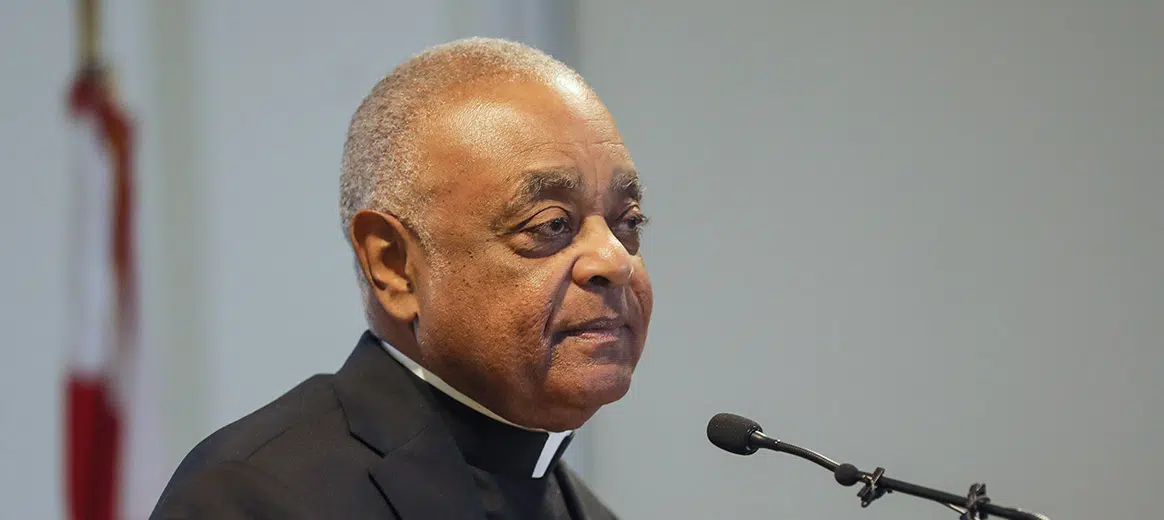
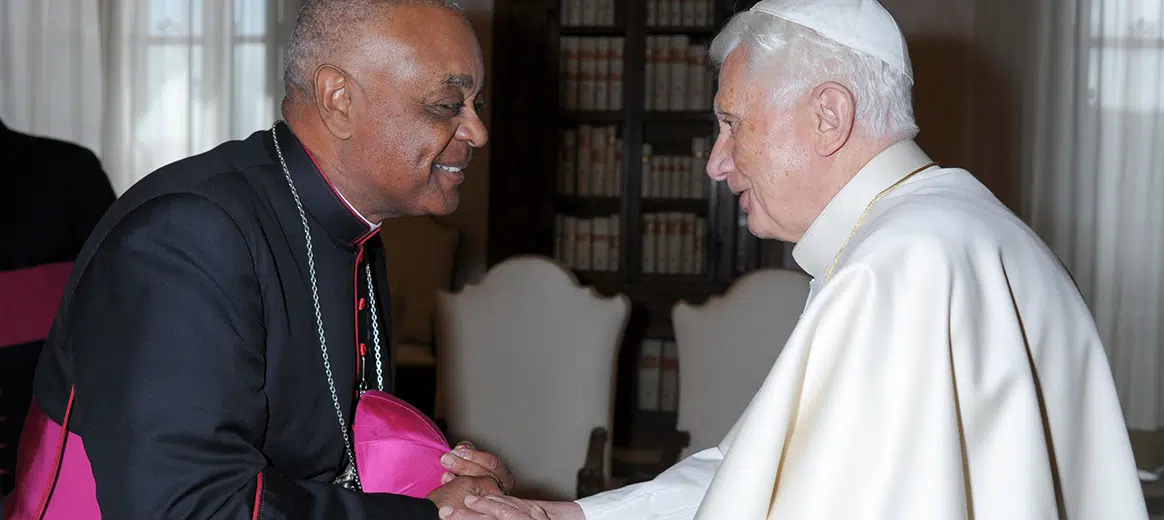
HYATTSVILLE, Md. — Archbishop Wilton D. Gregory, set to become
the new head of the Archdiocese of Washington, promised to serve with truth,
love and tenderness in a region where he acknowledged “unrest and
anger,” after the downfall of former Washington Cardinal Theodore E.
McCarrick and the church’s current sex abuse scandal.
“I want to offer you hope. I will rebuild your trust,”
Archbishop Gregory said during an April 4 news conference. “I cannot undo
the past, but I sincerely believe that together we will not merely address the
moments we’ve fallen short or failed outright, but we will model for all the
life and teaching of our Lord Jesus Christ and we will reclaim the future for
our families, for those who will follow us. That is my greatest, indeed, it is
my only aspiration.”
Archbishop Gregory was introduced to media gathered for the
announcement at the Archdiocese of Washington’s pastoral center in Hyattsville
by Cardinal Donald W. Wuerl. Pope Francis accepted Cardinal Wuerl’s resignation
as Washington’s archbishop in October and named him apostolic administrator.
The cardinal, now 78, had submitted his resignation, as is mandatory, to the
pope when he turned 75, but it had not been accepted until last fall.
Cardinal Wuerl had faced pressure to resign following an Aug. 14,
2018, grand jury report detailing past sexual abuse claims in six Pennsylvania
dioceses, which showed a mixed record of how he handled some of the cases when
he was bishop in Pittsburgh from 1988 until 2006.
Cardinal Wuerl also recently faced questions about what and when
he knew about past accusations involving McCarrick, who was stripped by Vatican
officials of his clerical status Feb. 16 after months of accusations that he
may have sexually molested minors and abused seminarians at various times and
places in his 60 years as a priest.
Cardinal Wuerl remains apostolic administrator until the
scheduled May 21 installation of Archbishop Gregory, who offered kind words for
his predecessor while acknowledging shortcomings.
“It’s difficult to come into a situation where there is
unrest and anger,” Archbishop Gregory said. “I’ve known Donald Wuerl
for over 40 years. He is a gentleman. He works very hard for the church. He’s
acknowledged that he’s made mistakes. That’s a sign of the integrity of a man.
If I can shed light on what I think we need to do in response to some of the
mistakes that he’s acknowledged and asked forgiveness for, I’ll do that.”
As he begins his tenure in Washington, following a 14-year stint
in Atlanta, Archbishop Gregory said he wants to spend time “in the
field.”
“For the foreseeable time, I’m not going to spend too much
time in the office,” he said. “I have to be in the parishes, I have
to meet with my priests. Why? Because I can’t be their archbishop if I don’t
give them an opportunity to tell me what’s in their hearts, to come to know me
and to establish a bond.”
He said he wanted to communicate to them his support, affection
and yearning to work for Catholics of the region. He acknowledged that
Washington, as the country’s seat of political power, may ask for political
savvy from its archbishop.
“I see this appointment to be the pastor of the Archdiocese
of Washington, I was not elected to Congress and so I intend to speak and
promote the church’s moral and doctrinal teaching that comes with the job, but
I think my involvement with the political engines that run here has to be
reflected through that prism,” he said. “I’m here as pastor. The
pastor must speak about those things that are rooted in the Gospel but I’m not
going to be at the negotiating tables. That’s not my place. My place is in the
pews with my people.”
Archbishop Gregory, 71, who will become the first African
American to head the Washington Archdiocese, fielded questions about civil
rights icon the Rev. Martin Luther King Jr., how he would handle dissatisfaction
in the pews, about him becoming Catholic when he was a teenager, and about
clericalism and its role in the sex abuse scandal. He spoke of advice he had
received from a priest before he went to study in Rome.
The priest told him that if he went to Rome, he would face three
temptations.
“You will face the temptation for self-aggrandizement,
temptation for pleasure and the temptation for power,” Archbishop Gregory
recalled. “And he said the most damaging temptation and seductive is that
for power and I think so much of what we are facing now was a misuse of power,
an abuse of power, clerical power. Power that was (used) in too many cases to
dominate and destroy lives.”
In some cases, clericalism manifested itself by “circling
the wagons, so the episcopacy wouldn’t call one another to task,” he said.
“I think this moment has shown the folly of that approach to
episcopal governance and episcopal collegiality,” he said.
And while “technical and structural responses” are
necessary to combat the abuse scandal the church is facing, “they alone
will never heal the heart of our people,” he said.
In the Archdiocese of Washington, which he called “home to
the poor and the powerful,” he promised transparency and truth and said
that during a time when the church had given the people in the pews many
reasons to leave, “I want to give them a few reasons to stay.”
“I want to assure the people what I will be honest with
them,” he said. “I’m an ordinary human being and I have to
acknowledge those things that I simply can’t handle perfectly or even at all,
but I always have to tell you the truth. And that’s been a theme here. I have
to tell you the truth and I will.”
Rebuilding trust during a moment fraught with challenges
throughout the church is not an easy task, he said, but added that he would
rely on the grace of God to do so at the local level.
“When my service to you has ended, you will know I came to
serve you with love, truth and tenderness in the name of the Lord Jesus,”
he said.