VATICAN CITY – After nine years of work involving Vatican
officials, English-speaking bishops around the world and
hundreds of consultants, Pope Benedict XVI received a
complete version of the English translation of the Roman
Missal.
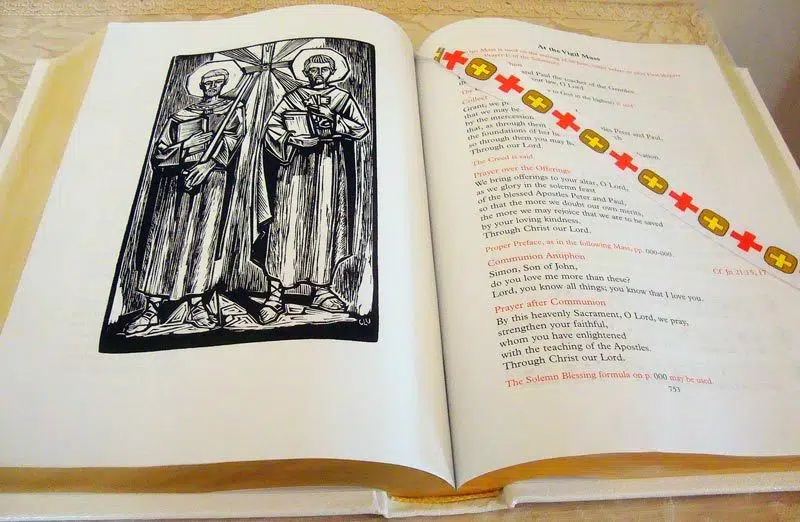
The white-bound, gold-edged missal, which contains all of the
prayers used at Mass, was given to the pope during a luncheon
April 28 with members of the Vox Clara Committee, an
international group of bishops who advise the Congregation
for Divine Worship and the Sacraments about English
liturgical translations.
“Soon the fruits of your labors will be made available to
English-speaking congregations everywhere,” the pope told the
Vox Clara members.
“Many will find it hard to adjust to unfamiliar texts after
nearly 40 years of continuous use of the previous
translations,” the pope said, which is why “the change will
need to be introduced with due sensitivity.”
The pope thanked the Vox Clara members and all those who
contributed to the translation process because “through these
sacred texts and the actions that accompany them, Christ will
be made present and active in the midst of his people.”
The new English-language Missal is a translation of the Latin
edition officially promulgated by Pope John Paul II in 2000
and released in 2002.
The copy given to the pope includes the “recognitio,” or
approval for use, dated March 25, 2010, and signed by
Cardinal Antonio Canizares Llovera, prefect of the worship
congregation, and U.S. Archbishop J. Augustine Di Noia,
congregation secretary.
Chicago Cardinal Francis E. George, president of the U.S.
Conference of Catholic Bishops, said that while the overall
text has been approved for use, editions with specific
adaptations for each country are pending. He said he expected
the “recognitio” for the U.S. version before the end of May.
While Catholics definitely will notice the new translation,
Cardinal George said, the change will be “far less dramatic
than going from Latin to English was.”
“When they see what a beautiful text it is, many people will
welcome it,” the cardinal told Catholic News Service April
29. Some people, for a variety of reasons, will not like the
translation, he said, “but in the end it will be the text the
church uses for prayer.”
Archbishop Terrence Prendergast of Ottawa, a member of Vox
Clara, told CNS that members expect bishops’ conferences in
most English-speaking countries to begin using the new
translation starting in Advent 2011.
After the Vox Clara meeting in January, the archbishop said,
members left Rome wondering if it would be finished in time
for the April meeting. The congregation and a group of
volunteers working with Msgr. James P. Moroney, former
executive director of the Secretariat for the Liturgy at the
U.S. Conference of Catholic Bishops, “made sure that every
line was checked and rechecked,” he said.
Before a copy was presented to the pope April 28, the Vox
Clara members were briefed on “how they brought the final
version together – how the final recensions were made, the
copy editing and the consultation with different people on
how it sounded,” he said.
Because the missal was translated in parts and approved in
sections by the various bishops’ conferences, some prayers
that are used only occasionally had been translated slightly
differently in different parts of the missal. The
congregation determined which of the translations to use
consistently, the archbishop said.
“While we may have had some reservations when we first
started the project – you know, ‘I’d rather this than that’ –
we began to see that the thing really came together and was a
wonderful work of collaboration among the different countries
of the world,” Archbishop Prendergast said.
“I think we have a majestic, reverent text that is going to
be a great contribution to the church,” he said.
The Latin missal text was translated into English by the
International Commission on English in the Liturgy, a body
established by English-speaking bishops’ conferences. The
conferences voted on each text and requested some specific
wording for use in their own countries. The texts approved by
the bishops’ conferences were forwarded to the Vatican for
approval. The congregation examined the texts with input from
the members of the Vox Clara Committee.