


BARNSTABLE, Mass. – Special Olympics founder Eunice Kennedy
Shriver, who died Aug. 11, was “a woman of ardent faith and
generous public service” in her work with the developmentally
and physically disabled, said Archbishop Pietro Sambi,
apostolic nuncio to the United States.
In a letter to Shriver’s family released to the press and
posted on the Special Olympics Web site, the archbishop
conveyed the condolences of Pope Benedict XVI.
He said the pope “unites himself spiritually with each of you
at this difficult time, holding close to his heart Eunice as
she is called home to eternal life and trusting in the words
of sacred Scripture: ‘What will separate us from the love of
Christ?'”
News reports said the 88-year-old Shriver, sister of the late
President John F. Kennedy, died in a hospital in Barnstable,
on Cape Cod. At her side were her husband, R. Sargent
Shriver, the couple’s five children and their spouses, and
the Shrivers’ 19 grandchildren. She had been in failing
health after suffering a couple of strokes and had been
hospitalized recently.
Funeral arrangements were pending. According to the Shriver
family, areas where people could pay tribute to her were
being set up at the Special Olympics headquarters in
Washington, the John F. Kennedy Presidential Library and
Museum in Boston, and the Kennedy museum in Hyannis, Mass.
A statement from the family said she was the light of their
lives as mother, wife, grandmother, sister and aunt “who
taught us by example and with passion what it means to live a
faith-driven life of love and service to others.”
It noted her deep devotion to Mary. “May she be welcomed now
by Mary to the joy and love of life everlasting in the
certain truth that her love and spirit will live forever,” it
said.
President Barack Obama called Shriver “an extraordinary woman
who, as much as anyone, taught our nation – and our world –
that no physical or mental barrier can restrain the power of
the human spirit.”
Special Olympics president and chief operating officer Brady
Lum thanked the public for such an “extreme outpouring of
support and prayer” for Shriver, whom he praised for having
“the vision to create our movement.” Her death is “an
enormous loss” but “her legacy will live on,” he added.
Eunice Kennedy Shriver was a member of one of the most
prominent American Catholic political families of the 20th
century. Born in Brookline, Mass., July 10, 1921, she was the
fifth of nine children of Joseph P. Kennedy and Rose
Fitzgerald Kennedy.
Her brother the president was assassinated in 1963 and
another brother, Sen. Robert F. Kennedy, was gunned down in
1968 as he campaigned for the presidency that year. Her
youngest brother, Sen. Edward Kennedy, has served in the U.S.
Senate since he was first elected in 1962 to fill his brother
John’s unexpired term after he became president. Since May
2008 he has been battling a brain tumor.
She and her husband had been married since 1953. R. Sargent
Shriver was the first director of the Peace Corps, an
initiative established during the Kennedy administration that
still sends thousands of Americans each year to
underdeveloped nations to help lift people out of disease and
poverty.
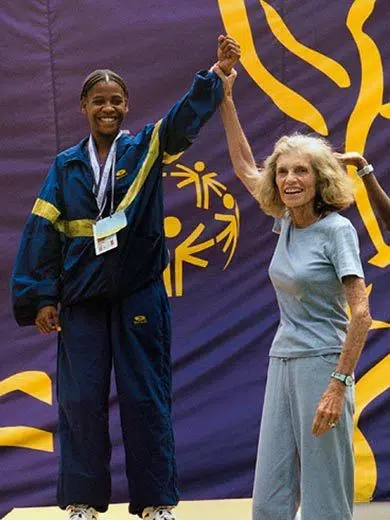
In 1968 she organized the first Special Olympics. She was
inspired to help the developmentally disabled achieve in life
by what her older sister, Rosemary, endured. She was born
with a mild form of developmental disability, but a frontal
lobotomy when she was a teen further reduced her mental
capacity. She died in 2005.
In 1976 Eunice Kennedy Shriver, in an essay written for a
Catholic magazine, called for a comprehensive “bill of
rights” for developmentally disabled Americans because those
rights “are under attack all over the nation.”
Shriver was a catalyst in getting a religious education
program for developmentally disabled adults launched in the
mid-1990s. When catechists met with Shriver and told her of
their years of wishing that they had such a curriculum, she
helped them secure the grant funds and told them, “Now make
it a reality.”
In 1990 she shepherded the development of a values education
curriculum, “Growing Up Caring,” with lessons to help
adolescents learn to care about themselves and others, and to
say no to sex, drugs and other pressures.
In 1972, a year before Supreme Court rulings legalized
abortion throughout the United States, she told a Birthright
convention in New Jersey that if women opposed to abortion
took in unwanted infants for three years until foster homes
could be found, there would be fewer abortions. Later that
year, she proposed a campaign called “One Million for Life”
to recruit 1 million people willing to adopt unwanted
children.
In 1975 she called for the establishment of “life support
centers” offering comprehensive services to those who want to
save life, encourage motherhood and support the family.
In a 1977 statement written for Catholic News Service’s
predecessor, NC News Service, as Congress debated a ban on
federal funding of abortion, she asked: “How do you equate
the life of an unborn infant with the social well-being of a
mother, a father or a family? If it is thought that the
social well-being of the mother outweighs the rights of
fetuses with congenital abnormalities, we do well to remember
that more than 99 percent of abortions are done on normal
fetuses.”
He pro-life stances earned her an award from Feminists for
Life in 2000, just one of many honors and awards she received
over the years. In 1989 she received the James Cardinal
Gibbons Award from The Catholic University of America in
Washington. She won the James Keller Award from the
Christophers, given to individuals for their work with young
people, in 1990, as well as the Catholic Theological Union in
Chicago’s Distinguished Service Award.
She received the Presidential Medal of Freedom, the nation’s
highest civilian honor, from President Ronald Reagan in 1984.
In 1988 she received the Laetare Medal, the highest honor
given by the University of Notre Dame in Indiana.
In 2006, Pope Benedict bestowed upon her the title of dame of
the papal order of St. Gregory the Great.
Shriver, who had a bachelor of arts degree from Stanford
University in California, received numerous honorary degrees
over the years, including ones from Boston College in 1990,
St. Mary’s College in Notre Dame, Ind., in 1987 and Loyola
College in Baltimore in 1994.
She was one of the early major contributors to Support Our
Aging Religious, which has aimed to reduce the unfunded
retirement liability of U.S. religious orders.
Contributing to this story were Mark Pattison and Julie Asher
in Washington.