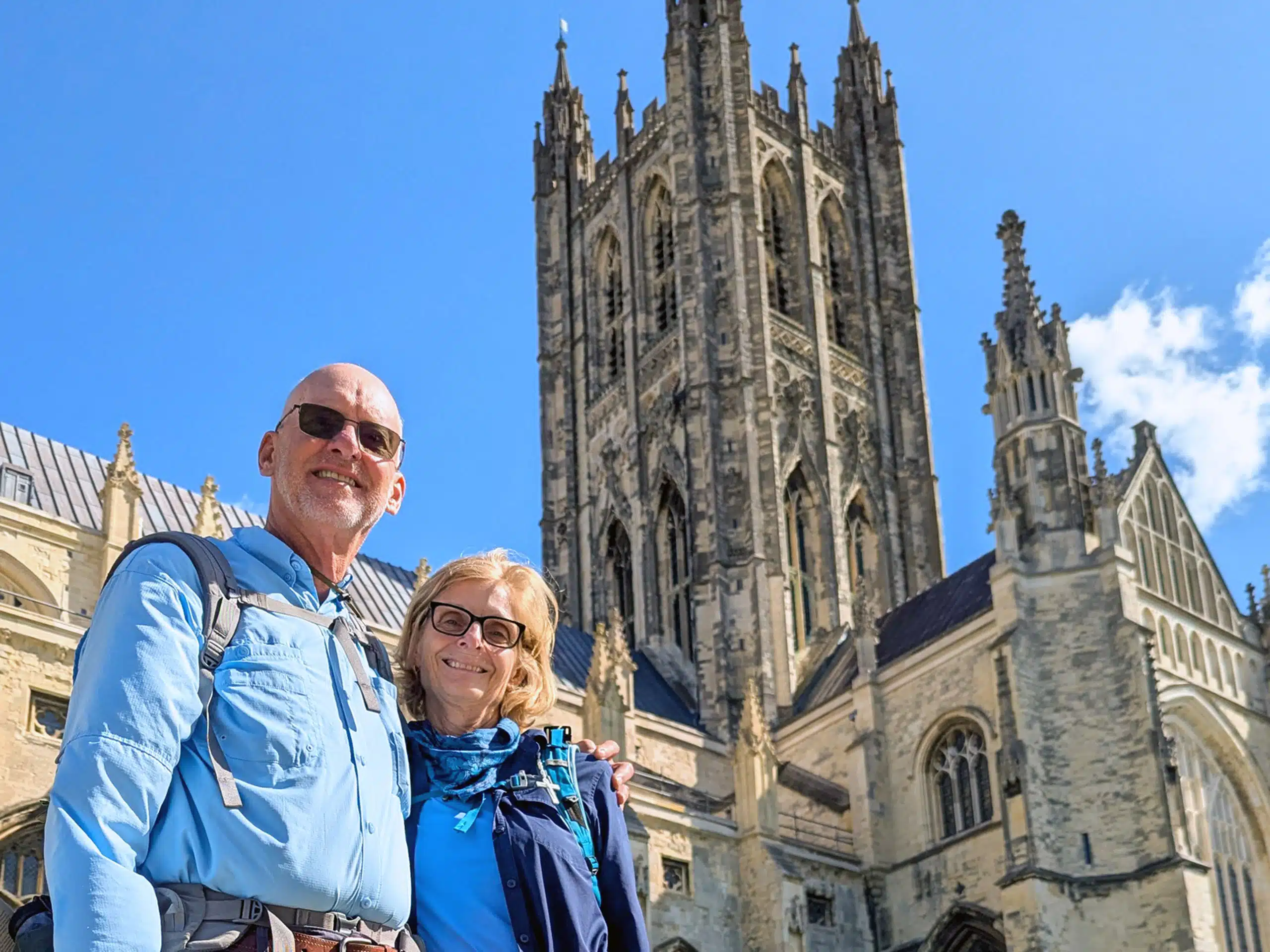
Maryanne and Peter Christensen still sound like newlyweds when they talk about one of the secrets to the success of their 44-year marriage.
“I was thinking of the Canterbury Tales and all the pilgrims who walked to Canterbury, and here I was, walking the same camino with my husband,” said Maryanne, who completed the St. Augustine Camino with Peter in August. The Christensens, who attend St. Elizabeth Ann Seton Church in Woodbridge, have also walked the Portuguese and French caminos. “This is something we do to grow closer to each other and to grow closer in Christ,” she said.
“We had actually scheduled a cruise,” laughed Peter. “And we wanted to burn off some calories before we went on the cruise.”
Not to be confused with the more famous St. Augustine of Hippo, the St. Augustine Camino is named after the monk known as the “apostle to England” who was sent to the British Isles by Pope Gregory in 597. The pilgrimage is a self-guided, 70-mile walking tour that honors the Christian conversion of England beginning in Rochester, just east of London to the Shrine of St. Augustine in the seaside town of Ramsgate.
“The thing that I found moving was the fact that there had been a Catholic culture in England that was senselessly destroyed for the whim of one king,” said Peter, referring to King Henry VIII, who broke with Catholicism in 1534 and destroyed monasteries when Pope Clement VII refused to annul his marriage. “It was very rewarding to walk through so many churches that all had their foundation in Catholic Christianity. Unfortunately, many of them are no longer Catholic, but the Catholic influence is inspiring.”
They prayed the rosary every morning and tried to time each day’s walk to attend Mass, averaging about 10 miles a day. “It’s extremely rewarding to get up in the morning, get on the pathway, and say a rosary with each other,” said Peter. “It keeps you centered on what’s really important.”
The path of the St. Augustine Camino is the same one taken by pilgrims for nearly a thousand years. “In Canterbury, we went to St. Dunstan’s Church where the head of St. Thomas More is buried with his daughter,” said Peter. “After he was executed, his head was stuck on a pole and she managed to bribe someone to get it.”
Canterbury was also the place where St. Thomas à Becket was murdered in 1170 after the priest challenged King Henry II’s royal control over the church. The shrine built in his honor was also destroyed by King Henry VIII in 1538.
“To walk into Canterbury Cathedral is just amazing,” said Maryanne. “You think of St. Thomas à Becket being murdered and then about what happened to his shrine.”
The Christensens, parents of Father Christopher P. Christensen, pastor of St. Rita Church in Alexandria, encountered no other pilgrims on the way. Both lean and fit at 70, they enjoyed a leisurely pace through ancient hamlets such as Thurnham, where they lodged and dined at the famous Black Horse Inn. Besides their daily photo journal on Facebook, everything else was intentionally low-tech.
“They say you carry your fears with you on the Camino,” said Peter. “So we carry our backpacks and you’ve got tons of things with you that you’re worried about like bandages and snacks. But the more you walk, the less you realize you need, much like living your life.”