Plans were already in the works for Catholic Charities to start
offering online English classes for immigrants later this year in the Arlington
Diocese — and then the coronavirus escalated into a global pandemic.
Staff shifted into high gear as social distancing measures and
stay-at-home orders were announced. “We went from zero to 60 very quickly,”
said Jackie Chavez, program director for Education and Workforce Development,
formerly known as Hogar Immigrant Services.
In-person classes teaching English for Speakers of Other Languages (ESOL) were supposed to start in mid-March, and
nearly 200 students had registered. But classes had to be postponed so program
staff could regroup and get the word out to both students and volunteers that classes
would be shifting online instead.
In record time, the Manassas-based staff of seven — all currently
teleworking — researched and tested distance-learning programs that were
approved by the Department of Education and put the word out to students and potential
teachers, not knowing what the response would be.
They were “happily surprised” to find so many people interested:
150 students registered for the first online session and another 150 signed up
for a second, Chavez said. More than 100 volunteers stepped forward to lead
classes.
“I am really excited about this new chapter,” said Moire Latamore
of Linden in an email. “Every year that I volunteer with Catholic Charities, I
am delighted by how much I learn about the many different cultures and the
people. Now, in addition to the pleasure of helping immigrants on their
journey, I get to learn a new 21st-century way to teach and reach out to
community.”
No foreign language proficiency is required for volunteer
teachers; lesson plans, curriculum, and training are provided. Volunteers are
asked to commit to teach one class a week for a 12-week semester.
“There’s been a lot of desire in the community to help,” said Jessica Estrada, diocesan
director of newcomer services. “The dedication of the teachers and volunteers
is part of what makes these classes special.”
Chavez said the online initiative has attracted a new group of
volunteers. “In the past, we had more retired people. Now we’re seeing people
who are younger. Lots of people didn’t have time for the commitment before, but
this is giving people who want to help, and have the ability, something they
can do from home.”
Classes include beginner to advanced ESOL as well as citizenship,
preparation for the General Educational Development (GED) high school
equivalency test, and ESOL for child care workers. Classes are usually offered
in Sterling, Woodbridge, Springfield, Manassas and Falls Church, but during the
coronavirus pandemic, all classes are online only.
The ESOL classes combine a Department of Education-approved
online curriculum developed by Burlington English and a “live” online classroom
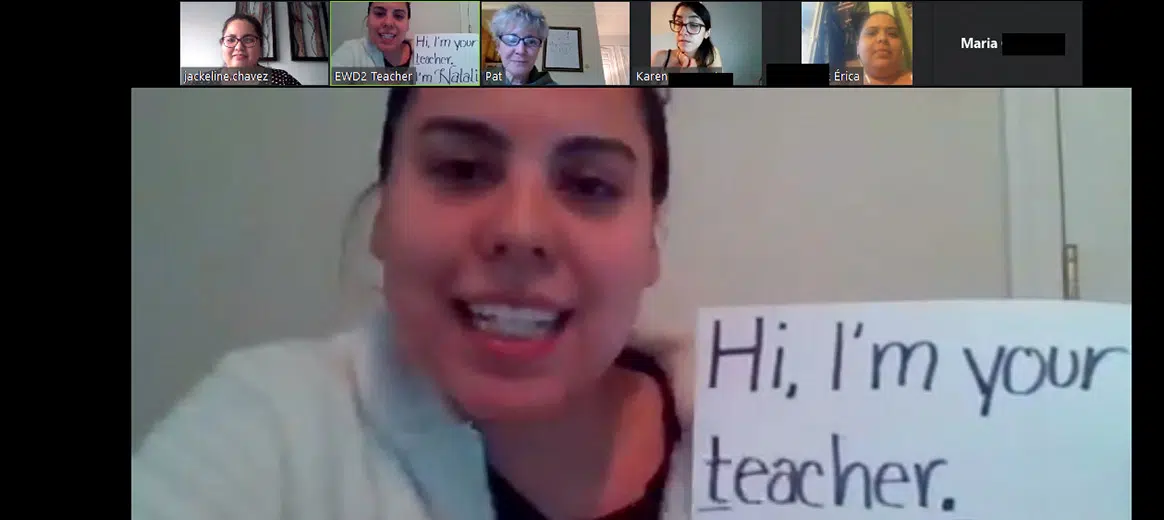
component using the Zoom videoconferencing platform. Zoom allows students to
see each other’s faces and receive instruction as if in a classroom, view the
teacher’s screen, and even break into subgroups for conversation practice or to
work in smaller teams.
“I get classroom instruction in my house, and I get to use a
great program that I can practice on,” said literacy student Yessenia Medina in
an email forwarded by staff. She said she had not used a computer since 2002
when she left El Salvador. “Using it again motivates me to continue to learn no
matter my age.
“My teachers, they are so patient,” she added. “I know teaching
already isn’t easy in person; now that everything is online, I am very thankful
for the amount of patience they have. It can be difficult sometimes for some
classmates, but they take the time to explain, and communicate with each
student.”
The curriculum provides more than 100 hours of content for each
learning level, and students can access the program at any time on their
cellphones, computers or tablets. That allows them to get extra practice, in
addition to the six hours of classes each week, said Maria Zuniga, education
services supervisor. Teachers can see how each student is doing, and if they
need extra help.
In a demonstration of the program on a Zoom video call, Zuniga
pointed out other useful features such as interactive worksheets and a small
onscreen microphone button that students can click to record their pronunciation
and get improvement tips. There’s also an online support tool that translates
text and other instructions into their native language when they need more
explanation.
Students come from about 60 countries, although the majority
speak Spanish, Farsi, Arabic or French, Zuniga said.
Estrada noted that while the focus is on learning English,
students can easily tap into other kinds of assistance if they need it. “We
have this connection to other Catholic Charities programs, so they can get
referrals for food, counseling or other services as well.”
For more information
To register for classes
or volunteer as a teacher, email [email protected] or go to the Education and Workforce Development website at
ccda.net/need-help/immigrants-and-refugees/english-classes/.